

Cognitive Behavioural Therapy (CBT) explained by Dr Elaine Ryan
I’m Dr Elaine Ryan (PsychD), Chartered Psychologist with the British Psychological Society. This guide explains Cognitive Behavioural Therapy (CBT), its use for OCD and anxiety, and how to explore treatment options in Dublin and across Ireland. CBT connects discussion with practical change. The work is tailored to the problem, with agreed goals and opportunities to practise between sessions. CBT is an evidence based talking therapy that helps you change unhelpful patterns in your thoughts, feelings and behaviour so you can get unstuck and move forward. I first trained in CBT as part of my doctoral training over 20 years ago. Alongside my clinical work and ongoing professional development, I’ve also supervised doctoral-level trainees during their CBT placements and given talks/lectures on CBT in professional conference settings.
CBT is a structured, collaborative therapy. We identify the pattern that’s keeping you stuck, map it clearly, and then change it step by step. For many people, the problem isn’t a lack of insight — it’s that the mind has learned an unhelpful “alarm-and-relief” cycle. You get a trigger, your anxiety spikes, you do something to bring it down (avoidance, checking, reassurance, mental reviewing, compulsions), and the relief teaches your brain: do that again next time. CBT works because it targets that loop directly.
CBT is used to help adults experiencing:

A first CBT session usually focuses on assessment: mapping thoughts, emotions, physical sensations and behaviours, identifying what maintains the problem, and agreeing a treatment plan with your therapist. Sessions then stay practical, with skills, experiments and a clear between-session plan.
Table of contents
CBT Therapy in Dublin & Online Across Ireland
CBT is available through trained practitioners in Dublin and across Ireland, including online services. The guidance below explains how to check qualifications and choose a therapist; my self-paced programmes provide structured explanations and practical exercises.
How to choose a CBT therapist | Explore self-paced CBT programmes
People often contact me after they’ve tried “talk therapy” that felt supportive but didn’t shift the pattern. That’s not a criticism of supportive therapy — it’s simply that certain problems (especially OCD and anxiety maintained by avoidance/reassurance) usually improve when treatment targets specific mechanisms: safety behaviours, threat monitoring, intolerance of uncertainty, and compulsive neutralising.
What CBT can help with



anxiety (including worry, panic, social anxiety, health anxiety, agoraphobia, depression / low mood, stress, anger and irritability, unhelpful self-criticism and confidence issues, avoidance, procrastination, and stuck patterns
What is a CBT session like?
CBT is collaborative and structured. Sessions usually include:
agreeing what you want help with (your goals)
mapping out patterns using the triangle (thoughts–feelings–behaviours)
learning practical tools you can use between sessions
reviewing what helped (and what didn’t) and adjusting the plan
CBT isn’t about “positive thinking”. It’s about more accurate, helpful thinking, and effective actions, so your life gets bigger rather than smaller.
I’ve made a quick video to explain what will happen in a CBT session with a therapist.
What is Cognitive Behavioural Therapy?
Cognitive Behavioural Therapy (CBT) is a practical, evidence-based therapy that helps you feel better by changing the patterns that keep you stuck. It helps to start with the core idea CBT is built on: in everyday life, three things are constantly interacting.
- Thoughts (what your mind says)
- Feelings (emotions + body sensations)
- Behaviours (what you do — and what you avoid)
When you’re anxious, low, or stressed, it can feel like being stuck on a hamster wheel — the same thoughts, feelings, and reactions going round and round. CBT helps you slow that wheel down and step off it by working with three things that constantly interact: thoughts, feelings, and behaviours.
How does CBT work?
CBT works by changing the belief systems holding you back and changing the things you do that keep your problem going. For example, if you believe you are not good enough, you might not apply for the job you want. It will not matter if, in reality, you are the best candidate, as your beliefs about yourself will hold you back.
CBT in 60 seconds: the triangle
CBT often uses a simple triangle because it explains so much, so quickly:

- Thoughts influence feelings and behaviours
- Feelings influence thoughts and behaviours
- Behaviours influence feelings and thoughts
Because it works in all directions, you don’t have to start by changing your thoughts. Sometimes the quickest shift comes from changing what you do.
A note on “ABC”: Some people call this the ABC triangle. In this guide I use A = Affect (feelings), B = Behaviour, C = Cognition (thoughts).
The simplest way to understand CBT: meaning matters
It’s not only what happens — it’s what your mind says happens. This is the very heart of the model – the cognitive part as how you interpret a situation is deeply personal to you, and can affect how you feel about and what you do in relation to it.
Two people can experience the same situation and feel completely different depending on the interpretation their brain makes. When we change the meaning we’re giving something (and the actions that follow), our feelings usually shift too.
These are sage words, meaning that nothing is good or bad; how you feel about a situation depends on your interpretation. They capture a core CBT idea: your feelings are shaped not only by events, but by your interpretation of events.
There is nothing either good or bad, but thinking makes it so.
Hamlet
A real-life example
Example. Sarah and John see a dog in the park. For Sarah, this event created fear as a dog chased her when she was a child, and she has been fearful ever since.
It delights John to see the dog, and he approaches it as he loves dogs. The event is the same, seeing a dog in the park, but two different people have different feelings about the dog based on their interpretation.
For Sarah, it means danger, and it means fun for John.
Same situation. Two different meanings. Two different emotions and behaviours.
That’s CBT in action.
The CBT triangle (Thoughts – Feelings – Behaviours)
CBT often uses a simple triangle:
- Thoughts influence feelings and behaviours
- Feelings influence thoughts and behaviours
- Behaviours influence feelings and thoughts
The example I use in session to explain further
A stands for the affect ( that is how you feel, or the emotion)
B is behaviour ( what you did, or did not do, or avoid.)
C is cognition (your thoughts)
This is how I always explain this concept in session; let’s say you see me on the other side of the street and you wave over, and shout hello. As you can see in the diagram,
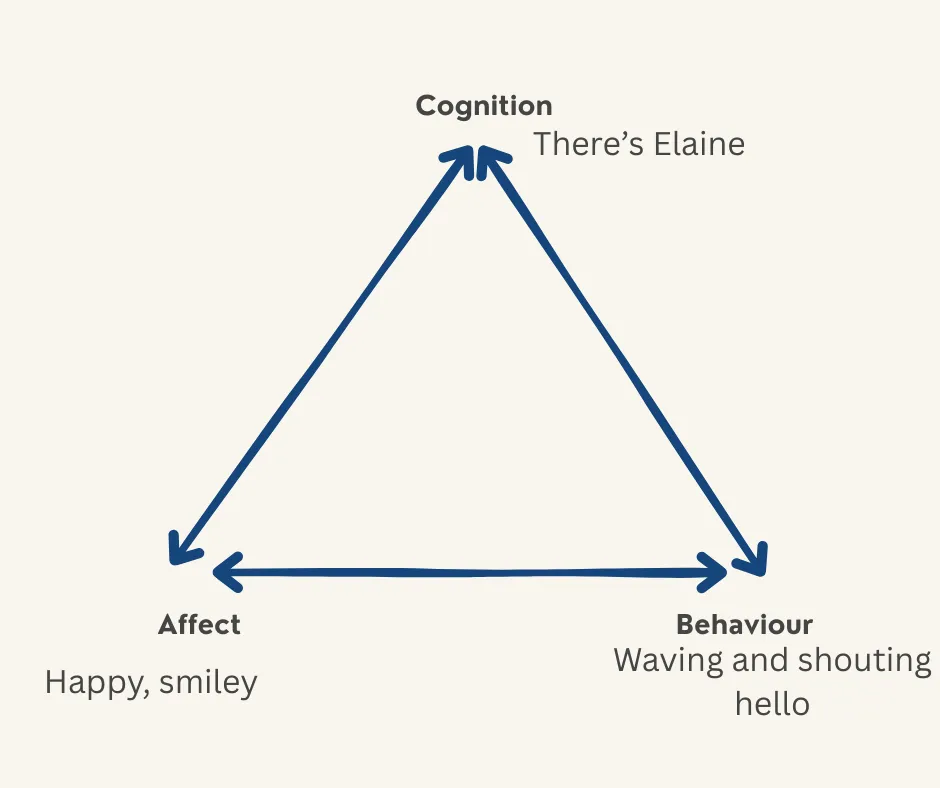
- thought -there’s Elaine
- behaviour – waving and shouting hello
- affect – happy
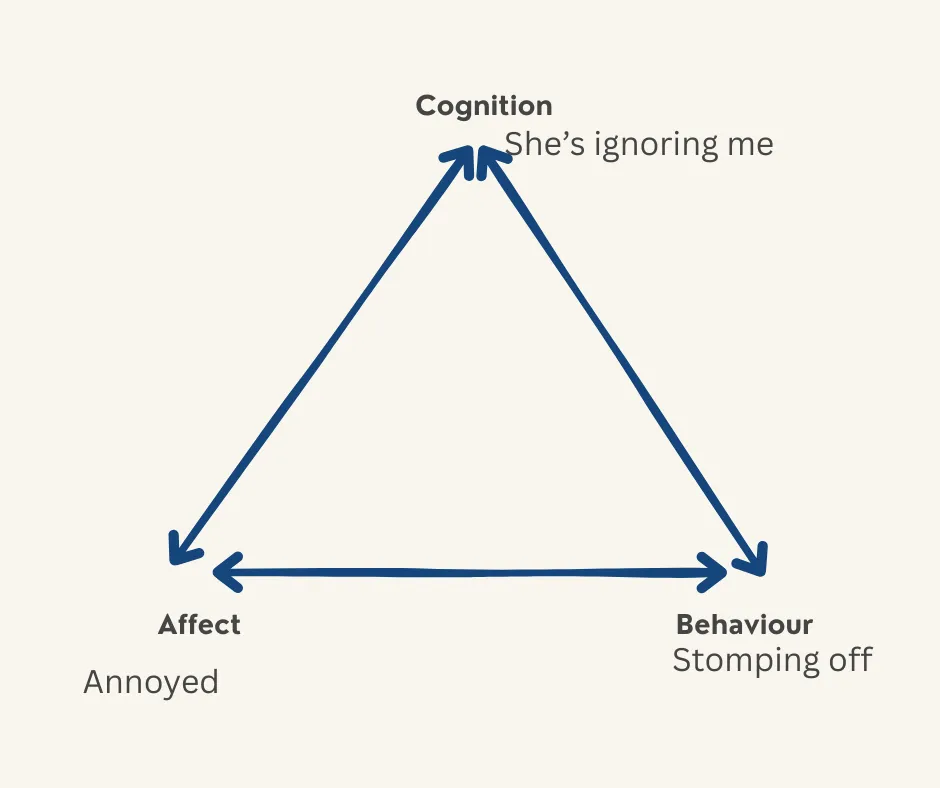
But wait to see what happens if I do not look over or do not wave back.
- thought -Elaine is ignoring me
- behaviour – you stomp off
- affect – angry
Behaviour-first change: a skills based example (CBT + DBT friendly)
Because it works in all directions, you don’t have to start by changing your thoughts. Sometimes the quickest shift comes from changing what you do; a behavioural change. This is making me think of my training in Dialectical Behavioural Therapy (DBT) where there is a part in the skills based training called opposite to emotion, where you literally do the opposite. For example if I invite you for a walk and you say not because you are sad, you literally do the opposite to what your emotions is telling you and go for the walk. Going back to what I was saying about how the triangle works in all directions, if you are feeling sad, it affects how the think, and the things you do, like not going for a walk, but if you change the behaviour and go for the walk, you have a fighting chance that your thoughts and mood shall change to. You interrupted and changed a vicious cycle.
I shall briefly explain how CBT helps by using the scenario above where the person did not apply for their dream job as they believed they were not good enough.
For example, if you believe you are not good enough, you might not apply for the job you want. It will not matter if, in reality, you are the best candidate, as your beliefs about yourself will hold you back.
- C is your cognitions, your thought processes and memories. How you talk to yourself inside your head.
- B is your behaviour- things you do, like sleeping, eating or avoiding something.
- T is for therapy.
CBT looks at negative automatic thoughts
The way CBT is used depends on the difficulty. For some anxiety problems, examining a prediction is useful. In OCD, repeatedly debating whether a feared thought is true can become a ritual; CBT that includes ERP also works directly on compulsions and the search for certainty.
As I stated above, it’s not events themselves that are bad, but the meanings you give to them. The job interview in my example above was not bad, but the person’s thoughts about themselves were not good. They thought they were not good enough. Repeated negative thoughts, such as
- I’m not good enough.
- I’m stupid
- others are better than me
It can stop you from getting what you want or feeling good about yourself. It also makes it hard to see examples when you are doing well, as it will not fit with how you view yourself.
Negative thoughts can become a self-fulfilling prophecy.
If the person in my example felt so low and had such critical thoughts about herself, she would think, ‘I won’t apply for the job.’
Having the belief in her head the thoughts are true; she does not give herself a chance to get the job. On the day the interviews are being held, she may worsen her thoughts; I’m a mess; it will upset my friends when they find out I didn’t even apply for the job. They’ll think I’m a loser.
Things go from bad to worse and strengthen the belief that she is not good enough.
Where Do These Negative Thoughts Come From?
Some can originate when you are pretty young if things you never seem to measure up to your parents’ expectations. For example, you got an on a test, but your parents asked why you did not get an A+.
You could grow up thinking that it is never good enough no matter what you do. I must be the best at everything I do to be good enough.
That last sentence was an example of a maladaptive assumption. I have to be best at everything I do to be good enough may have been adaptive as a child to get my parent’s praise, everything had to be perfect, but as a grown-up, it is tough to live up and become maladaptive. It also stops you from seeing when you are doing well.
Read more on negative automatic thoughts.
How will CBT help with negative thoughts?
First, it will make you aware of them as they can be so entrenched in how you are as a person that you may not notice them.
Undertaking CBT will not tell say are wrong; instead, it will allow you to set up experiments to determine whether your thoughts are accurate.
If not, it will show you how to change your thoughts to more helpful ones.
CBT and your self-talk
Self-talk is how you talk to yourself inside your head. More often than not, your internal dialogue can be pretty harsh, as shown in the video below. In the explainer video, you can see how the person feels terrible about herself based on the judgement she makes in her internal dialogue.
We call all the judgements and thoughts negative automatic thoughts in CBT, and they change your mood.
How effective is CBT?
CBT is widely used and well-researched. NHS describe it as an evidence-based talking therapy and explain how it’s used and accessed.
CBT is also recommended in clinical guidance for common problems like depression and anxiety disorders.
Where can I get CBT?
To explore CBT in Ireland, start by considering the practitioner’s training, experience with your difficulty and the format of support that suits you.
You can also access CBT through:
- working with a trained therapist in-person or online
- guided self-help (books/workbooks)
- structured online CBT programmes (availability varies)
You can also explore my structured self-paced programmes for practical CBT-based learning.
Who provides CBT in Ireland?
CBT can be provided by different professionals, depending on training and scope of practice. When you’re choosing a therapist, it’s reasonable to check professional registration and CBT-specific training/accreditation.
Some useful places to check practitioner listings include:
- PSI (Psychological Society of Ireland) Chartered Psychologist directory
- BABCP CBT Register (UK & Ireland)
- IACP (Irish Association for Counselling and Psychotherapy) directory
- Irish Council for Psychotherapy (ICP) Find a Therapist
Questions to ask a CBT therapist
Ask about their professional qualifications, CBT training and experience with your particular difficulty. Discuss how they assess your needs, what practice between sessions involves, how you will review progress, and the fees and cancellation terms. For OCD, ask specifically about their training and experience in exposure and response prevention (ERP).
My guide to choosing therapy or structured self-help explains how to compare your options.
FAQ’s
No. CBT can help with anxiety, panic, OCD, phobias, low mood, stress, sleep issues, confidence, and more. The key is whether there’s a pattern we can understand and change.
CBT providers may offer online sessions using structured tools and exercises. Ask how sessions work and whether this format suits your needs.
CBT works best when you practise between sessions, but it should be realistic. Your therapist can help you agree manageable practice between sessions.
That’s common — and it doesn’t mean therapy “isn’t for you”. Often it’s about finding the right approach, the right pace, and a clear plan. Ask how the practitioner will structure the work and review progress.
Yes. Intrusive thoughts are extremely common, and CBT approaches (including ERP for OCD where appropriate) can be very effective.
Browse the full collection of cbt cognitive behavioural therapy articles for more on this topic.
Related reading: how to restructure a negative thought.
- David, Oana & Matu, Silviu & Pintea, Sebastian & Cote?, Carmen Domnica & Nagy, Diana. (2014). Cognitive-Behavioral Processes Based on Using the ABC Analysis by Trainees’ for Their Personal Development. Journal of Rational-Emotive and Cognitive-Behavior Therapy. 32. 10.1007/s10942-014-0189-0.
- American Psychiatric Association. (2013). Diagnostic and statistical manual of mental disorders (5th ed.). Arlington, VA: American Psychiatric Publishing.
- Andrews, G., Basu, A., Cuijpers, P., Craske, M.G., McEvoy, P., English, C.L., & Newby, J.M. (2018). Computer therapy for the anxiety and depression disorders is effective, acceptable and practical health care: An updated meta-analysis. Journal of Anxiety Disorders, 55, 70-78.
- Comer, J.S., Chow, C., Chan, P.T., Cooper-Vince, C., & Wilson, L.A. (2017). Psychosocial treatment efficacy for disruptive behavior problems in very young children: A meta-analytic examination. Journal of the American Academy of Child & Adolescent Psychiatry, 56(1), 26-36.
- Hofmann, S.G., Asnaani, A., Vonk, I.J., Sawyer, A.T., & Fang, A. (2012). The efficacy of cognitive-behavioral therapy: A review of meta-analyses. Cognitive Therapy and Research, 36(5), 427-440.
- Magill, M., & Ray, L.A. (2009). Cognitive-behavioral treatment with adult alcohol and illicit drug users: A meta-analysis of randomized controlled trials. Journal of Studies on Alcohol and Drugs, 70(4), 516-527.
- Olatunji, B.O., Cisler, J.M., & Deacon, B.J. (2010). Efficacy of cognitive-behavioral therapy for anxiety disorders: A review of meta-analytic findings. Psychiatric Clinics of North America, 33(3), 557-577.