
Elaine’s Note: Checking & Reassurance
If you clicked this, it’s because your Health Anxiety Test showed that checking and reassurance are likely playing a strong role in your anxiety cycle.
This is one of the most common (and most fixable) maintaining mechanisms in health anxiety. It’s also one of the most misunderstood — because checking often looks like “being responsible.”
But clinically, checking becomes a problem when it functions as a safety behaviour: a way to reduce fear right now that unintentionally strengthens fear later.
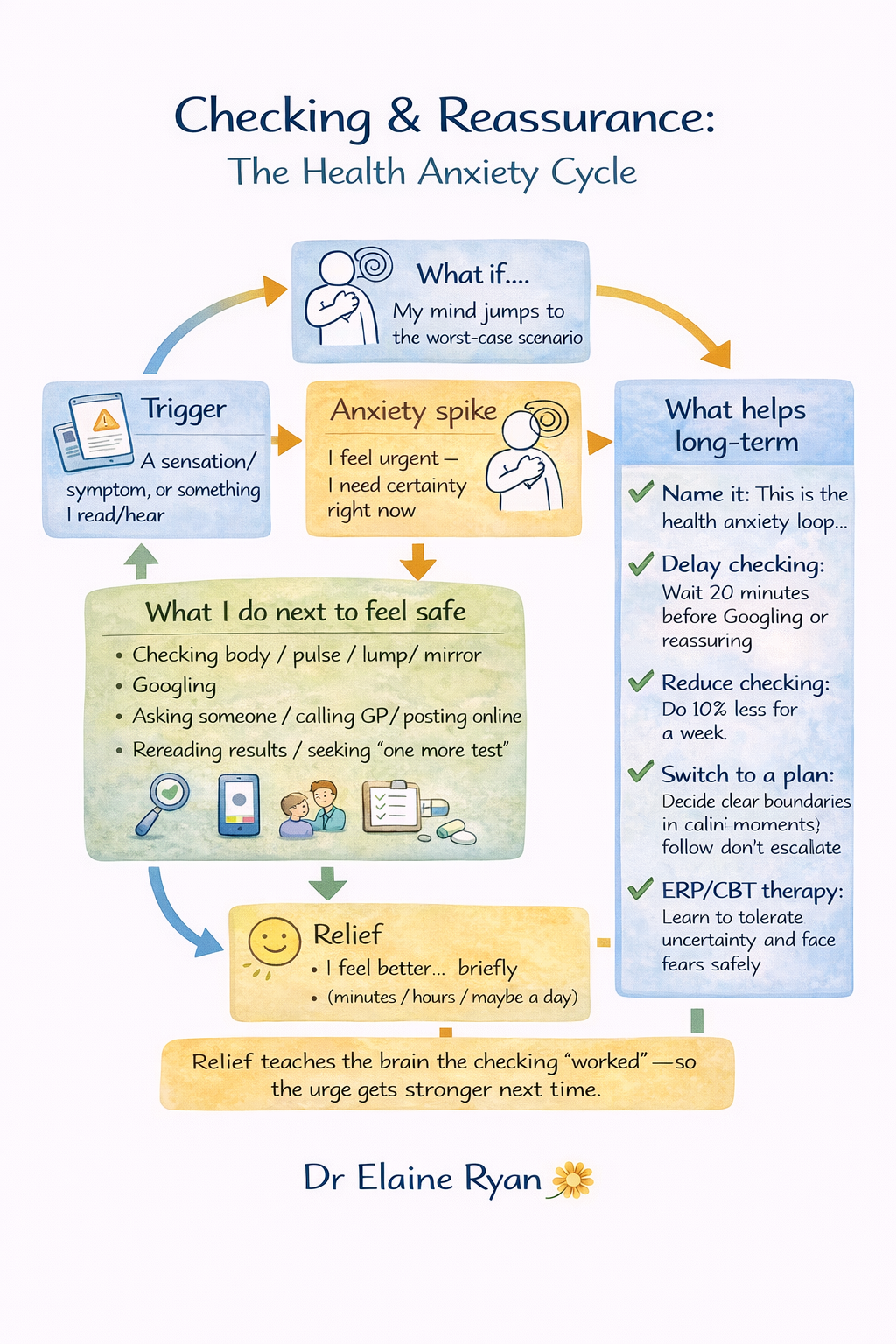
What checking & reassurance looks like in health anxiety
Checking can be obvious:
- checking pulse/heart rate
- checking breathing/swallowing
- examining moles, lumps, skin
- pressing areas to “test” pain
- re-reading results letters
- repeatedly scanning your body
Reassurance can be:
- asking a partner/friend “Do you think this is okay?”
- repeated GP visits for the same fear
- seeking a second opinion when the first didn’t settle it
- “just one more” symptom search online
- checking forums for “someone like me”
Why it maintains health anxiety (CBT mechanism)
Checking works like this:
- A trigger appears (sensation or health information)
- The mind interprets it as serious
- Anxiety rises
- Checking/reassurance reduces anxiety briefly
- The brain learns: “That was dangerous. Checking kept me safe.”
That learning is the problem.
The relief is usually short-lived because reassurance rarely gives the certainty the anxious brain wants. Instead, it often creates new questions:
- “But what if they missed something?”
- “But what if I didn’t describe it properly?”
- “But what if it’s changed since yesterday?”
So checking becomes compulsive. Not because you’re weak — because the brain is chasing certainty like a drug.
The difference between sensible care and reassurance-seeking
This is crucial.
Sensible health care is:
- noticing a new/worsening symptom
- seeking appropriate assessment
- following a clinician’s plan
- attending follow-ups as recommended
Reassurance-seeking is:
- repeating checks to reduce fear
- trying to eliminate uncertainty
- escalating to more checking when anxiety returns
If you have a genuine medical concern, the answer is not “ignore it.”
The answer is: use appropriate, planned medical care, not anxiety-driven loops.
What helps (and how to start without panicking)
You don’t stop checking by force. You reduce checking by training the brain that:
- uncertainty is tolerable
- you can cope without the safety behaviour
- the alarm does not need to be fed
Here are practical steps I’d use with you:
1) Choose one target behaviour (not all of them)
Pick the most common one:
- pulse checking
- body scanning
- asking for reassurance
- re-reading results
Don’t try to fix everything at once.
2) Delay the behaviour, don’t ban it
A powerful first step is delay:
- “I’m allowed to check, but I’ll wait 10 minutes.”
This teaches your nervous system it can come down without immediate certainty.
Once 10 minutes becomes possible, you move to 20, then 30.
3) One-check rule (where appropriate)
For some behaviours, the rule is:
- check once, then stop
- no “checking the check”
- no “just to confirm”
Not as a moral rule — as a nervous-system training rule.
4) Replace reassurance with a script
Reassurance-seeking often happens automatically in relationships.
A helpful alternative is a script like:
- “I’m having a health anxiety spike. I don’t need reassurance — I need support while I ride this wave.”
- “Can you help me do something grounding for 10 minutes?”
This keeps connection but removes the reassurance loop.
5) Track what happens after you don’t check
This is the behavioural experiment:
- anxiety spikes
- then it falls
- and your brain learns something new
The learning is the treatment.
A 7-day “gentle reduction” plan
- Day 1–2: delay one check by 10 minutes
- Day 3–4: delay by 20 minutes
- Day 5–7: reduce frequency by 10–20% (e.g., 4 checks ? 3 checks)
Small. Repeatable. Effective.
Checking is one of the biggest drivers of health anxiety — and it often needs structure, because anxiety is persuasive.
