
If you have agoraphobia, “face your fears” can sound overwhelming. Graded exposure means choosing a manageable step, practising it, and building from there. I’ll show you how to make a plan that starts where you are.
If you would like guided lessons and a workbook to use as you practise, my Agoraphobia Course takes you through the steps.
If you haven’t already done so, you can get more detailed information on agoraphobia in my main guide, and you can read more about the model of exposure and response prevention here.
If agoraphobia has shrunk your world down to “safe zones” — usually your home, certain routes, or only going out with a trusted person — the idea of facing your fears can feel overwhelming.
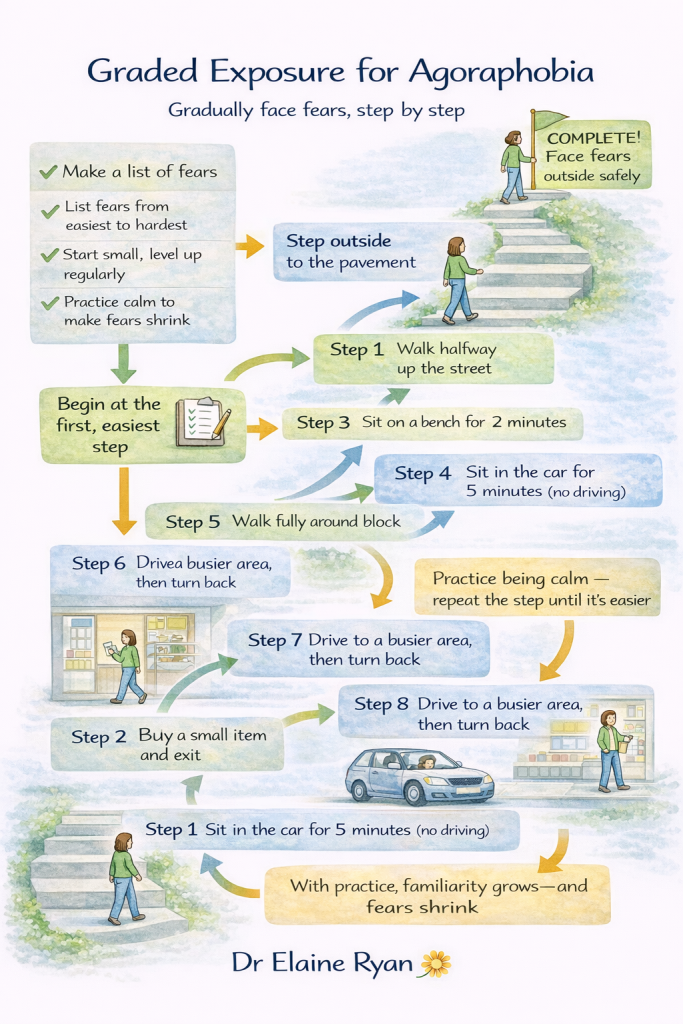
Graded exposure is a structured, gentle way of expanding your ‘safe zone’ : not by throwing yourself into the deep end, but by taking small, planned steps that retrain your brain’s fear response.
In this guide, I’ll show you what graded exposure involves, how to build your own practice ladder, and what to do if anxiety rises during a step.
1. What Exposure Is (and Isn’t)
When people hear “exposure therapy”, they often imagine the worst:
“They’ll force me onto a packed bus and leave me there until I crack.”
That’s not graded exposure.
What exposure is
Graded exposure is:
- Planned – you don’t just “wing it”; you choose situations in advance.
- Gradual – you start with easier steps and work your way up.
- Repeatable – you practise the same step until your anxiety reduces.
- Collaborative – ideally done with a therapist, but you still call the shots.
The aim is to teach your brain a new lesson:
“I can be in this situation, feel anxious, and still be safe. The fear goes up… and it also comes down.”
When you stay in a situation long enough for your anxiety to peak and then ease, your nervous system slowly stops sounding the alarm so loudly. Over time, that supermarket, bus, or café becomes just a place again — not a danger zone.
What exposure isn’t
Exposure is not:
- Flooding you into your worst nightmare without preparation.
- Proving how “strong” or “weak” you are.
- Something you “fail” if you feel anxious. (Feeling anxious is the point — we’re changing how you respond to it.)
- A quick fix you do once.
If anyone is pushing you into situations that feel unsafe, with no plan and no consent, that’s not good-quality exposure therapy.
2. Building a Hierarchy: Your Personal Exposure Ladder
A hierarchy (or ladder) is simply a list of feared situations, ordered from easiest to hardest.
You’ll use this to guide your work, starting with the mildest steps so your nervous system can build confidence.
I have a ready made worksheet to help you build your hierarchy that you are welcome to download if you would like to try this. The NHS recommends a stepped approach to treatment, so if you think you can start with self-help, this worksheet will get you going.
How to build your hierarchy
- Pick several areas or things that you have been avoided ( and don’t worry if even this stage makes you anxious, that is normal.
- Supermarkets
- Public transport
- Going for a walk alone
- Sitting in a café
- Driving beyond your “safe radius”
- List specific situations
Break it down as concretely as possible. “Go to Tesco” is too big. “Stand just inside the automatic door for 3 minutes” is clearer. This stage is extremely important and why exposure therapy breaks down with either a therapist that is not sure how to apply the model properly and pushes you too fast, or when you do not know how to ‘be specific.’ Let me spell it out, so you can try this by yourself.
If you have not been able to go to Tesco’s due to agoraphobia, setting a goal or going is too much, maybe even standing at the door is too much. When I am in session with people I always state that even thinking about going to Tesco’s can be the specific situation; you want something that provokes a little anxiety, but not so much that it will overwhelm you. You have to be specific- as in this example, the situation may be ‘thinking about Tesco.’ - Rate each one
Use a 0–10 fear scale.- 0 = totally calm
- 10 = “I’d rather do anything than this”
- Sort from lowest to highest
Your hierarchy should gradually climb from 2–3/10 tasks up to 8–9/10.
Example hierarchies
These are rough examples — you’d customise the details and ratings for yourself.
A. Supermarket hierarchy
- Stand at your front door with it open for 3 minutes (4/10)
- Walk to the end of your driveway / gate and back (4–5/10)
- Sit in the car outside a small local shop for 5 minutes (5/10)
- Stand just inside the entrance of the local shop for 2–3 minutes, then leave (6/10)
- Buy one small item at a quiet time, no trolley, and leave (6–7/10)
- Walk one full lap around a small supermarket without buying anything (7/10)
- Do a short shop (basket) in a larger supermarket at a quiet time (7–8/10)
- Do a normal weekly shop with a trolley at a busier time (8–9/10)
B. Public transport hierarchy (bus)
- Walk to the nearest bus stop (4/10)
- Sit at the bus stop for 5 minutes, then go home (5/10)
- Step onto an empty bus at the terminus, step off before it moves (5–6/10)
- Travel one stop and get off (6/10)
- Travel two stops, practising breathing throughout (7/10)
- Travel a short familiar route at a quiet time (7–8/10)
- Travel the same route at a busier time (8–9/10)
C. Social / café hierarchy
- Stand outside a quiet café for 3 minutes (4/10)
- Go inside, look at the menu, and leave (5/10)
- Order a takeaway coffee and leave (6/10)
- Sit inside with a coffee for 5 minutes, then leave (7/10)
- Sit for 15 minutes, no phone, practising grounding (7–8/10)
- Meet a friend there and stay for 30–45 minutes (8–9/10)
A therapist trained in CBT will help you refine a hierarchy that matches your triggers, and fits around panic disorder if that’s present. If you’re also dealing with panic attacks, your ladder might include interoceptive exposure(safely recreating bodily sensations like a racing heart in session).
3. Planning Your First Steps
Once you have your ladder, it’s tempting to jump to the “big win” — but graded exposure for agoraphobia works best when you start small and build a sense of mastery.
Choosing your starting point
Pick something around 3–5 out of 10 on your fear scale:
- High enough that you feel some anxiety
- Low enough that you’re genuinely willing to try it more than once
If you pick an 8/10 as your first step, there’s a higher chance you’ll feel overwhelmed and avoid going back — and the brain will log that as evidence too.
Prepare your “toolkit”
Before you do the exposure, decide:
- What skills you’ll use
- Slow breathing (in for 4, out for 6)
- Grounding: 5 things you can see, 4 you can feel, 3 you can hear, etc.
- Coping statements: “This is anxiety, not danger; my body is doing a false alarm.”
- How long you’ll stay
Enough time for anxiety to go up and start to settle — this is often 10–30 minutes, but start where feels realistic. - How you’ll track it
A simple journal is fine:- Where you went
- Starting anxiety (0–10)
- Peak anxiety (0–10)
- Anxiety after staying for a while
- Any thoughts like “I can’t cope” vs what actually happened
Over time, that notebook becomes evidence that you can cope, and that the feared catastrophe hasn’t happened.
4. Handling Spikes in Panic During Exposure
Even with the perfect plan, your nervous system will sometimes spike. That’s not failure — that’s the material we’re working with.
Here’s a simple script you can use during an exposure when anxiety surges:
- Name it“This is anxiety. My brain is in threat mode, but there is no actual danger.”
- Stay where you are — if it’s safe to do so
Rather than bolting immediately, see if you can stay for a few more minutes. Remember:- Panic always peaks and then falls.
- If you leave at the peak, the brain links “escapING” with “staying alive”.
- If you stay until it eases even a little, you teach your brain: “I can feel this and still be okay.”
- Use your body to help your brain
- Slow your breathing.
- Soften your shoulders, unclench your jaw.
- Feel your feet on the ground or the chair under you.
- Talk back to catastrophic thoughts
Instead of “I’m going to collapse in front of everyone”, try:“I’ve had this feeling before. It’s just my alarm system misfiring. I’ve never actually collapsed, and even if I got wobbly, people survive that.” - Rate your anxiety again after 5–10 minutes
Even a drop from 9/10 to 7/10 is a win. You’re teaching your brain that anxiety can move down as well as up.
When it is okay to leave
There are times when leaving is appropriate:
- You’ve stayed longer than planned and your anxiety isn’t shifting at all
- You feel truly unsafe (e.g. dizzy while driving – pull over first)
- You’re so flooded that you can’t use any skills
If you do leave, try to:
- Leave slowly rather than sprinting
- Keep breathing and talking kindly to yourself
- Note: “That was too big for today. I can choose a smaller step next time.”
The goal is not to white-knuckle through every exposure. The goal is to learn, adjust, and build up tolerance in manageable chunks.
5. When to Pause and Seek Support
Graded exposure for agoraphobia can be done self-guided, but there are clear points where it’s wise to get professional help.
Signs you’d benefit from therapy support
- You’re completely housebound, or nearly so
- You’re experiencing severe depression, self-harm thoughts, or very low mood alongside agoraphobia
- You also have health worries, OCD, or trauma that complicate the picture
- Your exposures repeatedly end in overwhelming panic and avoidance
- You’re using alcohol, tablets, or other substances just to get out the door
If you’re considering therapy, specifically graded exposure, talk to your GP first, as they can rule out other health conditions first and if necessary, refer you to HSE mental health services if needed. If waiting lists are long or you prefer to move sooner, you might consider private anxiety counselling.
Recap
Graded exposure for agoraphobia isn’t about facing your fears until you’re overwhelmed. It’s about:
- Understanding how your brain’s alarm system got stuck on high
- Giving it repeated, gentle chances to learn that you are safe
- Reclaiming everyday life — a walk, a shop, a bus journey — one step at a time
If your world has become very small, you don’t have to fix it all at once. Choose one tiny square of it — the gate, the corner shop, sitting in the car with the engine off — and start there.
Related reading: start when you feel housebound; practise the first few minutes outside; use a small shop and queue plan; understand agoraphobia and the recovery options.