
If you’ve read my previous posts, you’ll already know that health anxiety has a specific pattern
symptom > fear > checking/reassurance/Googling > short relief > fear returns.
it’s called the health anxiety cycle and you can see it more clearly in the image below. Read this article if you are new to health anxiety and want to understand it fully.
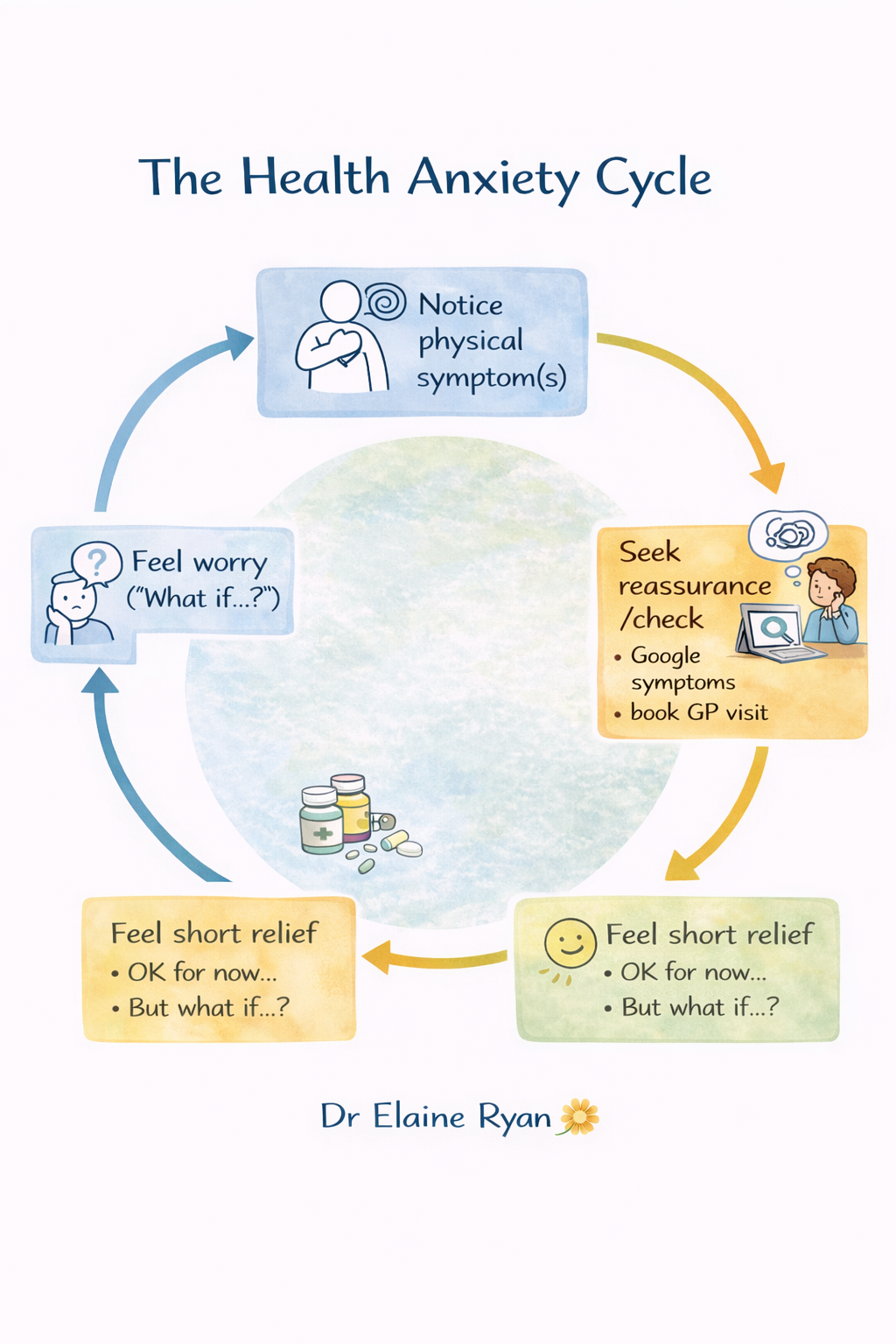
And this cycle of health anxiety needs a specific type of therapy and therapist: effective therapy is not the same as “someone kind to talk to about your worries.”
Kindness matters. Empathy matters. But health anxiety is one of those problems where too much reassurance (even well-meant reassurance) can keep the cycle alive whereas you need to be shown how to break the cycle. That’s why finding the right therapist matters.
This is a specialist area. In many ways health anxiety behaves like an OCD-type pattern: intrusive “what if?” thoughts, anxiety spikes, and then a compulsion to neutralise the fear by checking, researching, scanning your body, or seeking reassurance. ( you can learn what to do with health anxiety ‘what if’ thoughts here ) NICE guidance for OCD includes CBT with exposure and response prevention (ERP) as a core treatment approach. The same behavioural logic—gradually facing triggers while reducing “safety behaviours”—is often what helps with health anxiety too.
What Good Therapy for Health Anxiety Actually Looks Like
You’re looking for a therapist who can work with the mechanics of health anxiety, not just the feelings.
A very good starting point is: Do they understand checking and reassurance-seeking as part of the problem?
So in effective therapy, you should expect work like:
- Mapping your specific cycle (what triggers you, what you do next, what gives short relief, what keeps it going)
- Reducing safety behaviours (Googling, checking, repeated reassurance, repeated “just in case” appointments) in a planned way
- Behavioural experiments / exposure-style work (learning you can have sensations and uncertainty without urgently neutralising them)
- Cognitive work that’s practical (how you interpret sensations, catastrophising, probability neglect)
- Relapse prevention (a plan for setbacks, because health anxiety often flares during stress, illness, life changes)
If your therapy sessions never move beyond talking about fear and receiving comfort, it can feel lovely in the moment… but long term it will not help stop the cycle of health anxiety, a well meaning therapist can inadvertently keep you stuck.
Why “Supportive Talk Therapy” Can Accidentally Keep You Stuck
Health anxiety is often maintained by a very understandable belief:
“If I can get enough certainty, I’ll feel okay.”
But the nervous system doesn’t learn safety through certainty. It learns safety through tolerating uncertainty without doing compulsions.
That’s why reassurance can become a problem.
So if a therapist repeatedly does things like:
- endlessly analysing symptoms with you
- repeatedly reassuring you that you’re fine
- encouraging constant “monitoring” as a coping strategy
…they may be unintentionally playing the role that health anxiety wants them to play: the external regulator. It can turn into “reassurance therapy,” and the dependency can grow.
The right therapist will still be warm and validating—but the will understand that this is compulsive behaviour that you need to learn about and be shown how to stop.
Before you start treatment, you shall find these articles useful.
- How to speak to your GP about health anxiety
- Getting help for health anxiety in Ireland
- all health anxiety articles
The Skillset You Want Them to Have (In Plain English)
If you want therapy aligned with solid clinical guidance (like NICE), you’re generally looking for someone trained in structured, evidence-based approaches for anxiety, especially CBT-based methods. NICE guidance for anxiety conditions supports CBT as a key intervention in stepped-care models.
For health anxiety specifically, I’d look for a therapist who can confidently work with:
- CBT for health anxiety (very specific formulation; not generic stress management)
- Exposure/response-prevention principles (reducing checking/reassurance behaviours over time; borrowed from OCD treatment logic)
- Safety behaviour reduction (the “stop feeding the cycle” part)
- Work with uncertainty (because that’s where the fear lives)
- Collaboration with your GP (clear boundaries: when to seek medical review vs when it’s an anxiety spike)if you’re not sure how to speak with your doctor about health anxiety, this article will help.
The Questions to Ask Before You Book
You’re allowed to “interview” your therapist. It’s not rude. It’s wise.
Here are questions that cut straight to whether they can treat this properly:
- “How do you work with reassurance-seeking and checking?”
(Listen for: “We’ll reduce it gradually.”) - “Do you use a CBT model for health anxiety?”
(Listen for: a clear plan, not vague positivity.) - “How do you measure progress?”
(Good signs: fewer checks, less Googling, less avoidance, faster recovery after triggers, improved functioning.) - “What happens if I ask you to reassure me?”
(You want a therapist who can be kind and boundaried.) - “Do you set homework / between-session practice?”
(Not everyone loves the word “homework,” but real change happens between sessions.)
Green Flags and Red Flags
Green flags
- They can explain health anxiety as a cycle, not a personality flaw.
- They talk about checking/reassurance as maintaining behaviours.
- They’re confident setting boundaries around reassurance.
- They describe a structured plan (often CBT-based).
- They care about GP rule-out and sensible medical safety.
Red flags (kindly, not accusingly)
- The work stays in “talking about worry” with no behavioural change plan.
- They repeatedly reassure you in-session (especially about health).
- They encourage lots of symptom monitoring “for insight.”
- You feel dependent on sessions to feel okay, rather than more able to cope between them.
Credentials and Safety in Ireland
In Ireland, people practise under different titles and professional routes, so it helps to know what you’re looking at.
Good starting points for verifying a practitioner:
- PSI (Psychological Society of Ireland) Chartered Psychologist Directory (for psychologists recognised as Chartered Members).
- IACP “Find an Accredited Therapist” (counsellors/psychotherapists on their directory).
- IAHIP Directory (accredited psychotherapists searchable by county/speciality).
- ICPA Accredited Directory (another Irish directory of accredited practitioners).
Online vs In-Person: What Actually Matters
For health anxiety, online therapy can work extremely well because the work is often:
- skills-based
- behaviour-focused
- about changing responses in real life
What matters more than the room you sit in is:
- do they understand the cycle?
- do they reduce safety behaviours?
- do they help you practise outside sessions?
The First Session: How to Get the Most From It
There is no two ways about it, private therapy is expensive. Go in with three things:
- Your pattern (not a symptom encyclopaedia):
“When I notice X, I worry it means Y, then I do Z to feel better.” - Your main maintaining behaviours (be honest):
checking, Googling, scanning, reassurance, repeated GP visits. - Your goal in functional terms:
“I want fewer checks, fewer spirals, and to live normally even when sensations show up.”
A good therapist will validate you and start building a plan.
A simple next step
If you take only one thing from this article, let it be this:
Choose a therapist who can treat the process of health anxiety, not just soothe the fear.
The fear is real. The sensations are real. And the cycle is treatable.