
A lot of people manage to calm anxiety down just to find it comes back again. Today I want to help explain that by showing how everything is connected, and although really it’s a really useful skill being able to calm yourself down, you need to work with all the other interconnected parts to fully recover from anxiety and stop it coming back.
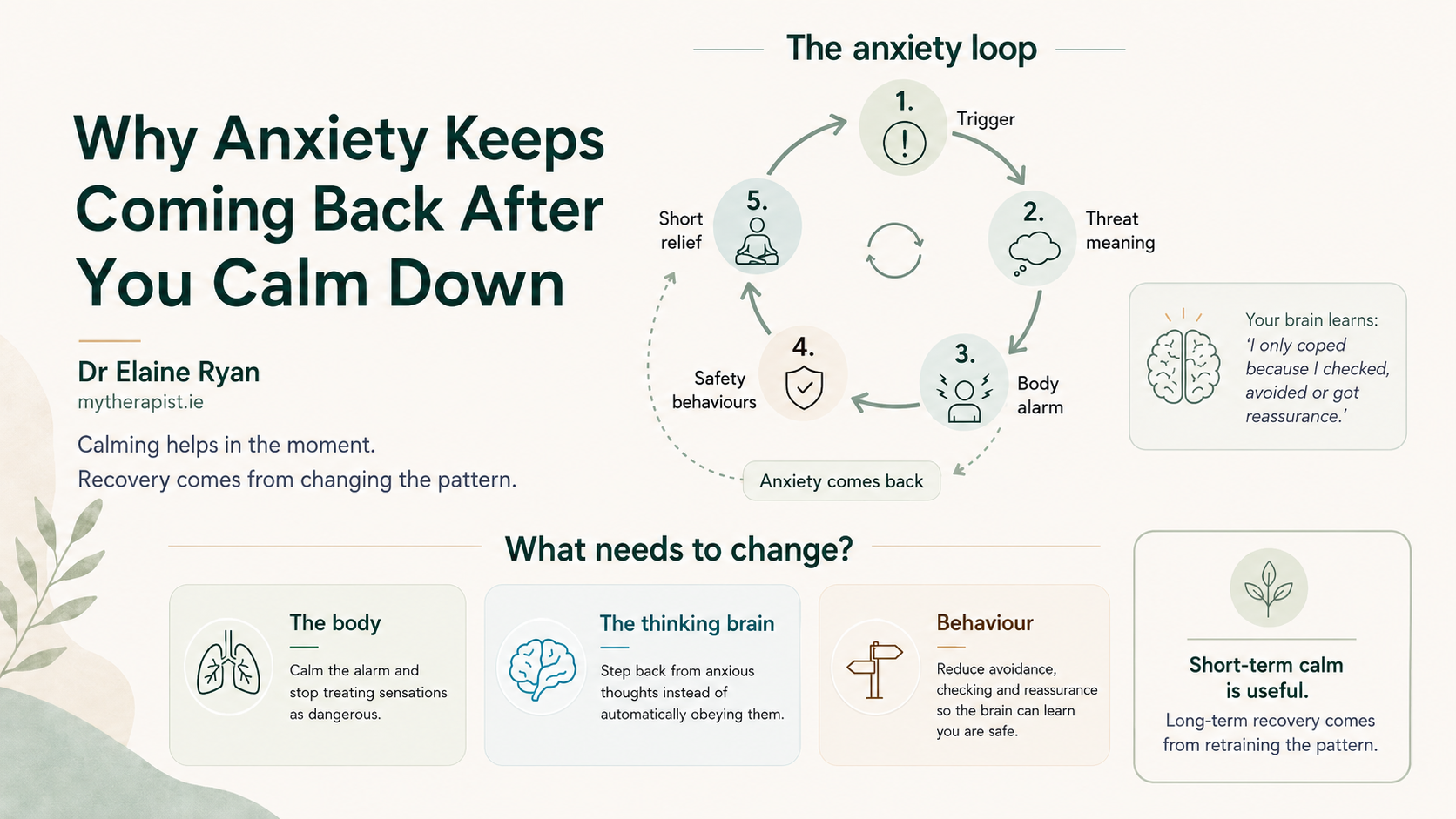
Table of contents
- Anxiety is not just a feeling
- Why quick calming does not always change anxiety
- The hidden behaviours that keep anxiety alive
- The anxiety loop
- What structured CBT does differently
- Why I use the phrase “Retrain Your Brain”
- The three places anxiety needs to change
- Exercises you can try today
- Why reassurance does not solve it
- What recovery feels like at first
- When to get more help
- Recap
Common calming techniques people and myself use;
They breathe.
They distract themselves.
They get reassurance.
They avoid the thing that frightened them.
They have a better day.
They tell themselves it has passed.
Then the anxiety comes back.
This is one of the most frustrating parts of anxiety, and it is often the point where people start thinking:
“Why am I not getting better?”
The answer is usually not that you are doing nothing.
The answer is often that you are doing things that reduce anxiety in the moment, but do not change the pattern that keeps bringing it back.
That distinction matters.
Calming anxiety is useful. But calming anxiety is not always the same as retraining anxiety.
That is the difference I want to explain.
Anxiety is not just a feeling
Anxiety feels like a feeling, but clinically I think of it as a whole pattern.
It involves:
- body alarm
- threat prediction
- attention narrowing
- anxious thoughts
- memories of previous fear
- avoidance
- reassurance seeking
- safety behaviours
- habits your brain has practised
This is why anxiety can feel automatic.
Your body can react before you have had time to think clearly.
Your mind then tries to make sense of the reaction.
You might think:
“Why do I feel like this?”
Then the thinking brain starts searching.
What if something is wrong?
What if I panic?
What if I cannot cope?
What if this never goes away?
What if I embarrass myself?
What if I lose control?
The anxiety is no longer only in the body. Now it is in the thoughts, the meaning, the attention and the behaviour.
Why quick calming does not always change anxiety
There is nothing wrong with breathing exercises, grounding, relaxation or distraction, I use them therapeutically with clients and in all my courses, they are an integral part of anxiety management.
They can help you get through a difficult moment.
The problem starts when calming becomes the only goal.
If your brain learns:
“I can only cope if I make anxiety go away first,”
then anxiety remains in charge.
You wait to feel safe before you act.
You wait to feel calm before you leave the house.
You wait to feel certain before you decide.
You wait to feel confident before you do ordinary things.
That sounds sensible, but it can keep life small.
Anxiety recovery usually means learning to act while some anxiety is still present.
Not recklessly. Not by forcing yourself through everything. But gradually, repeatedly, with a plan.
The hidden behaviours that keep anxiety alive
Many people think they are “doing nothing” about anxiety, when in fact they are doing a lot.
They may be:
- avoiding places
- avoiding conversations
- seeking reassurance
- checking how they feel
- scanning the body
- over-preparing
- staying close to exits
- carrying “just in case” items
- replaying situations
- asking others what they think
- Googling symptoms
- cancelling plans
- waiting until they feel right
These behaviours reduce anxiety briefly.
That is why they are so tempting.
But they also teach your brain:
“That situation was dangerous, and I only got through it because I escaped, checked, prepared, asked or avoided.”
So the brain stays on alert.
The next time, the anxiety comes back faster.
The anxiety loop
The loop often looks like this:
Trigger
A situation, body sensation, thought, memory or demand.
Threat meaning
Your brain decides it could be dangerous.
Body alarm
Adrenaline, tension, racing heart, stomach changes, dizziness, heat, breathlessness.
Anxious behaviour
Avoiding, checking, asking, escaping, overthinking, preparing, scanning.
Short relief
You feel better.
Long-term learning
Your brain learns that the trigger was dangerous and the safety behaviour saved you.
That last part is the problem.
Your brain does not learn:
“I was safe.”
It learns:
“I escaped.”
Or:
“I only coped because I checked.”
Or:
“I only managed because I avoided the hardest part.”
This is why anxiety returns even when nothing bad happened.
What structured CBT does differently
CBT is not just “change your thoughts.”
That is too simplistic.
Good CBT looks at the full pattern:
- what triggers anxiety
- what meaning you give it
- what happens in your body
- what you do next
- what gives short relief
- what keeps the cycle alive
- what needs to be practised differently
The HSE describes CBT-based digital programmes as helping people learn CBT and use it to support mental health and wellbeing. In practice, the important word is use.
You do not just understand CBT.
You practise it.
That means learning to respond differently when anxiety appears.
Why I use the phrase “Retrain Your Brain”
I use that phrase because anxiety is learned in the brain and body.
That does not mean you chose it.
It means your nervous system has learned to react in a certain way, often after repeated stress, fear, panic, avoidance or difficult experiences.
The good news is that learned responses can be updated.
But your brain does not update just because you read something once.
It updates through repeated new experiences.
That is why a structured programme can help. It gives you the same ideas in a sequence, with exercises, so you can practise rather than just read.
The three places anxiety needs to change
1. The body
You need to understand the physical alarm system.
A racing heart, tight chest, shaking, dizziness, stomach upset or breathlessness can feel frightening. But if the body sensations themselves become the threat, anxiety becomes self-fuelling.
You need ways to calm the body, but also ways to stop treating normal anxiety sensations as dangerous.
2. The thinking brain
The thinking brain tries to predict, analyse and prevent danger.
That can be useful.
But with anxiety, it often turns into worry, rumination, catastrophising and “what if” thinking.
The goal is not to never have anxious thoughts. The goal is to stop automatically obeying them.
If you haven’t already done so, I recommend reading my main article on anxiety where it describes the role of the three brains in more detail.
3. Behaviour
This is where many people miss the work.
If you keep avoiding, checking, escaping or seeking reassurance, the brain keeps learning that anxiety is dangerous.
Change usually requires doing things differently.
Small, repeated, planned practice matters more than one big dramatic effort.
Exercises you can try today
Choose one anxiety pattern.
Not the hardest one.
Write down:
Trigger: What set off the anxiety?
Meaning: What did my mind say it meant?
Body: What did I feel physically?
Behaviour: What did I do to feel safer?
Short relief: Did it calm me briefly?
Long-term cost: Did it keep the anxiety pattern going?
Example:
Trigger: I felt dizzy in a shop.
Meaning: “I might faint or panic.”
Body: Heart racing, weak legs.
Behaviour: Left quickly and went home.
Short relief: Anxiety dropped.
Long-term cost: My brain learned shops are dangerous.
Now ask:
“What would be one small different response next time?”
That might be staying for two extra minutes.
It might be going to a smaller shop first.
It might be not checking your pulse.
It might be walking around one aisle before leaving.
It might be letting the dizziness be there without immediately escaping.
This is how you begin retraining.
Why reassurance does not solve it
Reassurance is another common reason anxiety keeps returning.
You ask, “Do you think I’m okay?”
You feel better.
Then doubt comes back.
This is not because the reassurance was bad. It is because the brain learns to rely on reassurance.
The message becomes:
“I can only settle if someone else confirms I am safe.”
That makes confidence weaker, not stronger.
In treatment, the goal is not to remove all support. The goal is to reduce the need for repeated reassurance and build your own ability to tolerate uncertainty.
What recovery feels like at first
People sometimes expect recovery to feel like calm.
At first, it may feel like doing something while anxious.
You go to the shop with anxiety still there.
You send the email without rereading it ten times.
You let the body sensation pass without checking.
You leave the question unanswered.
You stay in the situation long enough for your brain to learn something new.
That is not failure.
That is the work.
The learning is:
“I can feel anxious and still cope.”
Over time, that changes the pattern.
When to get more help
A self-help course can be useful for mild to moderate anxiety, especially when you can work independently and practise consistently.
One-to-one therapy or GP support may be more appropriate if anxiety is severe, you are at risk, you cannot function, you are very depressed, or you feel unable to practise alone.
The important thing is not to wait for anxiety to disappear before you begin.
Start with a safe, realistic step.
Recap
Anxiety keeps coming back when the underlying pattern has not changed.
You can calm the feeling and still keep the loop alive.
Real progress means understanding what your brain has learned, spotting the behaviours that maintain anxiety, and practising a different response repeatedly.
Practise changing the pattern
If you want a structured way to practise, my self-paced Retrain Your Brain programme brings together lessons on understanding anxiety, CBT, thoughts, beliefs and behaviours, mindfulness and relaxation. You can explore the curriculum and preview lessons before deciding whether the course suits you.
That is why structured CBT can be useful.
Not because it gives you one clever trick.
Because it teaches a new pattern.
And anxiety changes when the pattern changes.