
Relationship OCD is treatable, but the treatment needs to target the process that keeps the doubt alive.
What keeps the doubt alive? Some therapists, although well-meaning, may allow you to spend months talking about whether the relationship is right, listing evidence for and against their partner, or trying to understand why a particular thought appeared. But unfortunately this keeps the doubt going, and it is this process that needs targeted in treatment.
Good treatment does not decide whether you should stay or leave. It helps you recognise all the above as obsessions and part of obsessive compulsive disorder, reduce compulsions and tolerate enough uncertainty to experience the relationship—and your wider life—more directly.
ROCD is a commonly used name for an OCD presentation in which symptoms focus on a relationship, a partner or one’s feelings. It is not a separate formal diagnosis. A clinician assesses OCD and the particular way it is showing up.
Table of contents
- What an assessment should cover
- CBT with ERP is the main psychological treatment
- What a good ROCD treatment plan looks like
- What ERP should not do
- Medication
- How to choose a private therapist
- Routes to treatment in England, Scotland, Wales and Northern Ireland
- Self-help and online programmes
- Where to start this week
What an assessment should cover
An assessment is more than asking whether you have doubts. Psychologists are trained in psychological assessment and formulation, and as such I would recommend an assessment from either a psychologist or psychiatrist. Doubts are common in relationships.
A clinician should explore:
– the intrusive thoughts, images, urges and feelings;
– how much time they occupy;
– the distress and effect on work, sleep, relationships and daily life;
– visible compulsions such as asking, checking, comparing, avoiding and confessing;
– covert compulsions such as reviewing memories, monitoring attraction and arguing internally;
– the short-term relief and longer-term consequences of those behaviours;
– previous or current OCD themes;
– depression, anxiety, trauma, substance use, eating difficulties or other relevant conditions;
– medication, physical health and sexual-health factors where relevant;
– relationship safety, coercion, abuse and concrete problems;
– risk to yourself or other people.
A questionnaire can support assessment but should not make the diagnosis by itself. Nor can a clinician infer that every relationship concern is OCD once a person has the diagnosis.
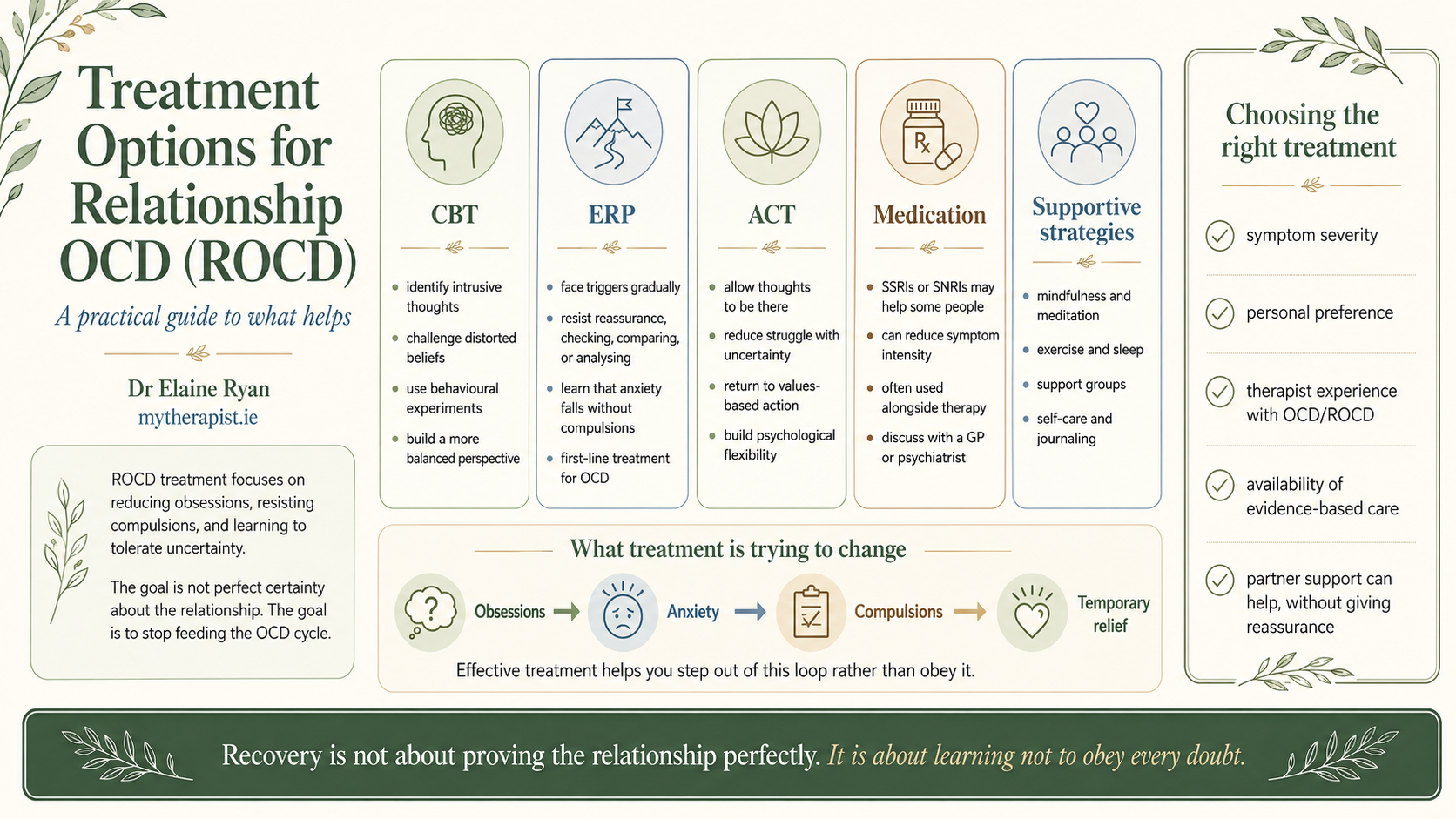
CBT with ERP is the main psychological treatment
UK NICE guidance and NHS information recommend cognitive behavioural therapy that includes exposure and response prevention for OCD. The HSE also identifies CBT with ERP as the most effective psychological treatment for OCD.
The strongest treatment evidence is for OCD as a whole. ROCD-focused work applies the same core principles to relationship triggers and compulsions, informed by the developing ROCD research literature.
Exposure means deliberately making contact with a manageable trigger, thought or uncertainty rather than organising life around avoiding it.
Response prevention means reducing the behaviour used to neutralise the trigger or obtain certainty.
For ROCD, an exposure might be:
– allowing the thought, “Perhaps this is not the perfect relationship”;
– looking at an ordinary, imperfect photograph of a partner;
– hearing a friend speak enthusiastically about their relationship;
– planning one commitment-related task;
– spending time with a partner while feelings are mixed;
– allowing an intrusive attraction or critical thought to be present.
Response prevention might mean:
– not checking whether love is present;
– not comparing with an ex or stranger;
– not asking a partner for reassurance;
– not reviewing the early relationship;
– not confessing the thought;
– not searching online;
– not repeating a reassuring phrase in your head.
The aim is not to prove the relationship is right. If an exposure is secretly designed to make you feel love or attraction, it has become another test.
What a good ROCD treatment plan looks like
A useful plan is individual rather than a generic list of frightening statements.
It usually includes:
A shared formulation. You and the clinician map your triggers, meanings, emotions, compulsions, relief and long-term cost. You should understand why each exercise is being proposed.
A graded hierarchy. Work begins with tasks that are challenging but manageable, then develops. ERP is not a contest in distress.
Overt and covert response prevention. Stopping reassurance while continuing four hours of mental review will limit progress. The therapist must ask what happens in your head.
Practice between sessions. Learning comes from repeated experience in daily life, not discussion alone.
Values and functioning. Treatment should help you return to work, friendship, rest, intimacy and chosen behaviour—not merely reduce a symptom score.
Partner involvement where useful. A partner may learn how to reduce reassurance and accommodation while remaining supportive. They should not become the therapist or police every compulsion. See my guide for partners affected by ROCD.
Relapse planning. Doubt will return. The plan is to recognise the cycle earlier and respond differently, not to guarantee a permanently certain relationship.
Some clinicians also use acceptance and commitment therapy ideas, mindfulness or compassion-based approaches within treatment. These may help a person make room for thoughts and act according to values. They should not replace exposure and response prevention when compulsions and avoidance are maintaining OCD.
What ERP should not do
ERP is sometimes described carelessly online.
It should not:
– tell you that you definitely love your partner;
– instruct you to stay in a relationship;
– force a break-up to test your reaction;
– prescribe marriage, sex, moving in or having a baby as an exposure;
– expose you to violence, coercion, humiliation or danger;
– require sexual contact without free consent;
– dismiss a concrete relationship problem as “just OCD”;
– demand maximum distress from the first session.
Major life decisions have real consequences. ERP targets the compulsive process that interferes with decision-making; it does not make the decision for you.
Medication
Medication used for ROCD is medication for OCD rather than a separate ROCD drug.
NHS, NICE and HSE guidance commonly refer to selective serotonin reuptake inhibitors (SSRIs) for OCD. Clomipramine may be considered in some circumstances. Medication choice, dose, interactions, side effects and duration require a prescriber such as a GP or psychiatrist.
OCD often requires different prescribing considerations from depression, and benefit may take time. Do not start, stop or change medication on the basis of an article. Speak with the prescriber, particularly if you experience severe side effects, worsening mood or thoughts of self-harm.
Medication may be used alone or with CBT/ERP depending on severity, preference, previous response, availability and clinical advice. It can reduce symptom intensity for some people; it does not teach response prevention by itself.
How to choose a private therapist
The label “OCD specialist” is not enough. Ask direct questions before committing to treatment:
1. What formal training and current professional registration or accreditation do you hold?
2. How much of your work involves OCD and ERP?
3. How do you identify mental compulsions such as reviewing and feeling-checking?
4. Can you give an example of how you would build a graded ROCD hierarchy without deciding the relationship for me?
5. How do you handle reassurance-seeking within sessions?
6. How do you distinguish OCD from concrete safety or relationship issues?
7. What practice would I do between sessions?
8. How will we review progress if anxiety does not fall quickly?
In the UK, practitioner psychologists can be checked on the HCPC Register. Accredited CBT therapists can be checked on the BABCP CBT Register. Professional title and route matter, but specific competence in OCD and ERP still needs to be established.
In the Republic of Ireland, statutory CORU psychology registers are not yet open as of July 2026; CORU currently expects the first psychology registers in 2027. Check current professional membership, qualifications, insurance, complaints process and specific OCD/ERP training. The BABCP register, Cognitive Behavioural Psychotherapy Ireland and the Psychological Society of Ireland may help with credential checks, but none replaces asking about actual ROCD competence.
Warning signs include a therapist who repeatedly reassures you that the relationship is correct, promises certainty, has no clear response-prevention plan, treats ERP as flooding, or tells you to make a major relationship decision for therapeutic reasons.
Routes to treatment in England, Scotland, Wales and Northern Ireland
Services change, so use the official links rather than relying on an old directory.
England
You can speak with your GP. In England, adults can also usually self-refer to NHS Talking Therapies for non-urgent treatment. When making contact, describe the time spent on obsessions and both visible and mental compulsions; do not rely only on the term ROCD, which every assessor may not use.
Scotland
Speak with your GP or use local NHS mental-health routes. NHS inform provides a current CBT-based OCD self-help guide for mild-to-moderate symptoms. NHS 24 is available on 111 for urgent help that is not a 999 emergency.
Wales
Contact your GP or local NHS psychological-therapy service. NHS 111 Wales provides OCD treatment information and local service guidance. Access arrangements vary by health board.
Northern Ireland
Start with your GP, who can assess and refer to services within your Health and Social Care Trust explains the general route. For crisis support in Northern Ireland, Lifeline is available on 0808 808 8000; call 999 where there is immediate danger.
OCD Action, OCD-UK and Mind also provide UK information and support. A support group can reduce isolation, but it is not a replacement for individual treatment where symptoms are severe or complex.
## Routes to treatment in the Republic of Ireland
Speak with your GP, who can discuss treatment, medication where appropriate, and referral through local HSE services. The HSE’s OCD treatment page describes CBT with ERP and medication options.
OCD Ireland offers information and support groups, including options for family, friends and carers. It does not itself provide treatment or guarantee particular clinicians.
Private care may be online or in person. Confirm where the clinician is professionally based, what regulatory framework applies, how emergencies are handled, and whether they are legally and professionally able to work with a client in your location.
Self-help and online programmes
Structured self-help can be useful for some people, particularly where symptoms are mild to moderate, the person can practise consistently and risk or complexity is low. It may also support work with a clinician.
Self-help is less suitable as the only support when there is severe depression, suicidal thinking, major functional impairment, psychosis, an unsafe relationship, complex trauma, substance dependence, or difficulty understanding and applying ERP safely.
A structured ROCD self-help programme should help you map obsessions, identify overt and mental compulsions, build graded practice and reduce reassurance. Self-help is educational rather than individual diagnosis or therapy, and it should not tell you whether to stay in a relationship.
Where to start this week
Do three things:
1. Write down one obsession and the exact behaviours—out loud and in your head—that follow it.
2. Contact an appropriate service or clinician and ask specifically about OCD and ERP.
3. Begin reducing one manageable compulsion rather than trying to settle the relationship question.
The most useful early sign of treatment is not that you suddenly feel certain. It is that you begin to recognise the loop and have a different choice when it starts.
References and further reading
– NICE CG31: OCD and body dysmorphic disorder — treatment
– International OCD Foundation: Relationship OCD
–