
If you have social anxiety, “get help” can sound simple until you actually have to do it. Making the call and talking to people is the very thing you need help with; that fear of judgement can stop you from getting started.
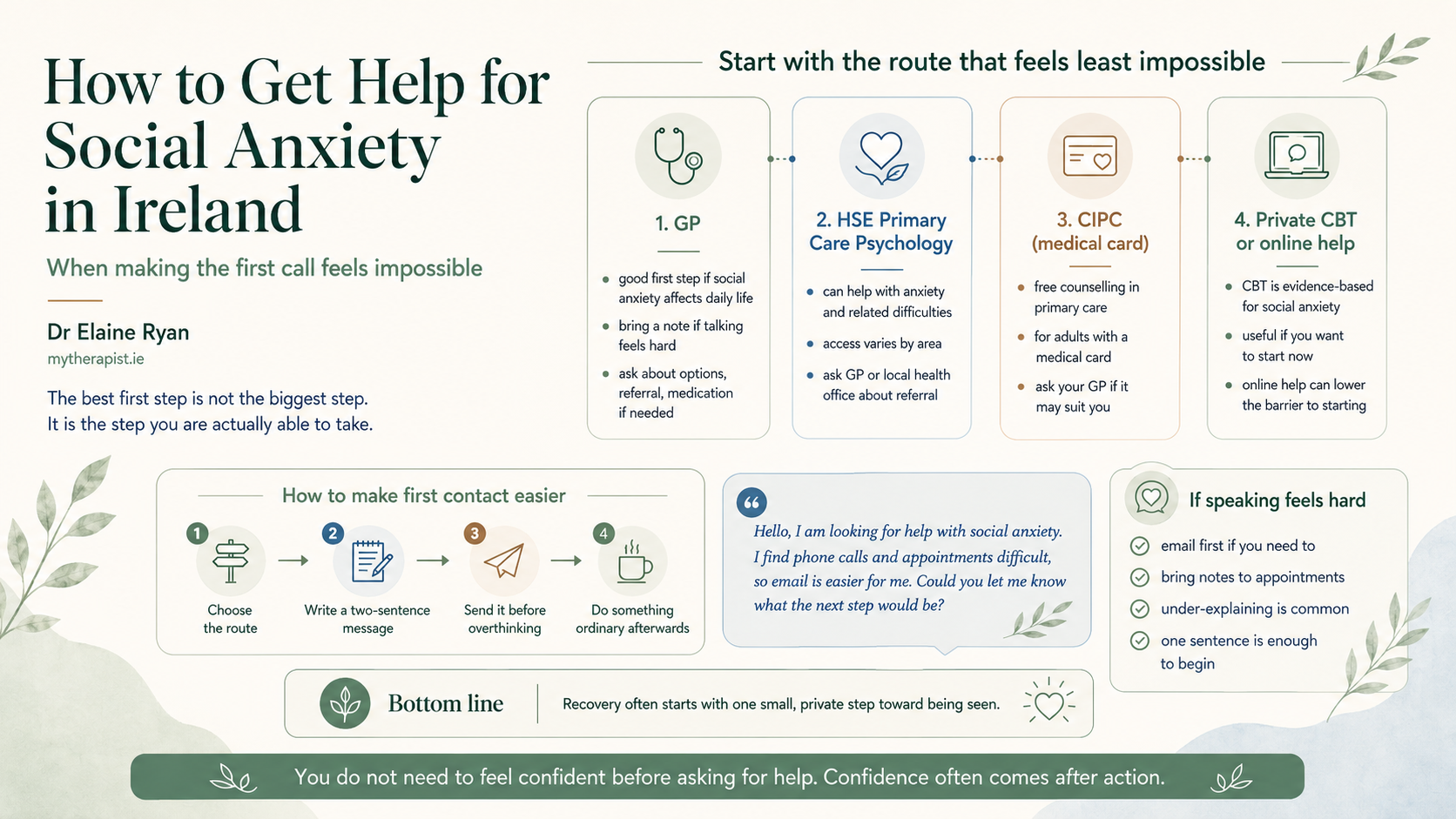
You may know you need support, but the first step itself can contain the very things you are frightened of: ringing a GP surgery, explaining yourself to a receptionist, sitting in a waiting room, talking to someone new, or saying out loud that you are not coping.
So I want to slow the whole thing down and make it more practical. This article is not a lecture telling you to be brave. It is a guide to getting help in Ireland when the act of asking for help is part of the problem.
Table of contents
- Start with the route that feels least impossible
- Option 1: Talk to your GP
- Option 2: HSE Primary Care Psychology
- Option 3: Counselling in Primary Care if you have a medical card
- Option 4: CBT for social anxiety
- Option 5: Online help or structured self-help
- How to make the first contact easier
- When to seek urgent help
- The first step counts even if you feel anxious doing it
If you think you have social anxiety, we are not just taking being shy. It is a recognised anxiety disorder. The HSE describes it as an overwhelming fear of social situations that can affect everyday activities, self-confidence, relationships, work and school. That matters because it means you are not asking for help because you are weak. You are asking for help because something treatable is affecting your life.
Start with the route that feels least impossible
There is no single correct starting point. Some people start with their GP. Some start with a private therapist. Some start with a self-help programme because they cannot yet speak to anyone. Some contact a service by email before they can manage a phone call.
A good first step is not the biggest step. It is the step you are actually able to take.
If ringing feels too much, write a short email to your GP surgery or therapist. If writing the full story feels too much, write one sentence:
I think I may have social anxiety and I would like help, but I find it hard to talk about it.
That is enough to begin.
Option 1: Talk to your GP
Your GP is often the best starting point in Ireland, especially if social anxiety is affecting your work, college, relationships, sleep, mood or ability to leave the house. If making the appointment is the difficult part, I have a separate guide on what to say to your GP about social anxiety.
You do not need to arrive with the perfect explanation. In fact, many people with social anxiety understate their distress when they are face to face with a professional. They may smile, seem polite, and say “I’m fine really,” even though they have spent the whole morning dreading the appointment.
Before you go, write down the things you might not be able to say. Bring the note with you, or hand it to the GP at the beginning.
You might write:
– I avoid phone calls, meetings, eating in front of people, or meeting new people.
– I worry for days before social situations.
– I replay conversations afterwards and feel ashamed.
– I am turning down opportunities because of fear of being judged.
– I think I need help but I find it hard to ask.
Your GP can talk through options, rule out other issues where needed, discuss medication if appropriate, and refer you to public or private supports.
Option 2: HSE Primary Care Psychology
HSE Primary Care Psychology can help with anxiety, panic, phobias, obsessions, self-esteem and related difficulties. It may include assessment, guided self-help, group therapy, advice clinics or talk therapy.
Access can vary by area. The HSE says a GP or another health professional can refer you, and in some cases you can self-refer by contacting your local health office and asking for a Primary Care Psychology referral form. Waiting times can vary and may be long, so it is worth asking your GP what is available locally and what you can do while waiting.
If you are on a waiting list, you are not doing nothing. Use the time to understand your pattern, reduce avoidance gently, and gather information for your first appointment.
Option 3: Counselling in Primary Care if you have a medical card
If you are 18 or older and have a medical card, you may be eligible for Counselling in Primary Care, often called CIPC. The HSE describes this as free counselling through the National Counselling Service, with up to eight sessions depending on your needs. You need a referral from your GP or another health professional.
CIPC is not designed for every level of difficulty, and your GP can help decide whether it fits. But if cost is stopping you from seeking help, it is worth asking about it directly.
A sentence you can use:
I have a medical card and social anxiety is affecting my life. Could you tell me whether Counselling in Primary Care or another HSE service would be suitable?
Option 4: CBT for social anxiety
Cognitive Behavioural Therapy, or CBT, is one of the main evidence-based treatments for social anxiety. For social anxiety, good CBT is not simply positive thinking. It looks at what keeps the fear going: self-focus, safety behaviours, avoidance, mental rehearsal before events and replaying afterwards.
This is important because many people with social anxiety already understand that their fear is “probably excessive.” That insight alone does not necessarily change the alarm in the body. CBT helps you test what your anxious mind predicts and teaches your nervous system through experience.
If you are looking privately, ask whether the therapist has experience treating social anxiety specifically, and whether they use CBT or behavioural experiments for social anxiety. You can check directories such as the Psychological Society of Ireland, IACP, or Cognitive Behavioural Psychotherapy Ireland depending on the type of professional you are looking for.
Option 5: Online help or structured self-help
Online help can be useful for social anxiety because it lowers the barrier to starting. You do not have to sit in a waiting room. You can begin from home. For some people, that privacy makes it possible to say things they would otherwise hide.
But online help is not all the same. There is live online therapy, guided CBT, self-paced courses, books, apps and group programmes. The question is not “is online help good or bad?” The question is: what level of support do you need?
If social anxiety is mild to moderate and you are able to practise skills, structured self-help may be a good starting point. If you are severely avoidant, depressed, misusing alcohol to cope, or barely functioning, please involve your GP or a qualified professional.
How to make the first contact easier
Here is a tiny plan.
Do not decide that you have to “sort your life out.” Your first job is only to make contact.
1. Choose the route: GP, HSE, private therapist, or structured self-help.
2. Write a two-sentence message.
3. Send it before your anxious mind starts rewriting it for the tenth time.
4. Do something ordinary afterwards: kettle on, short walk, shower, one email.
This is not avoidance. This is pacing.
Your message can be as simple as:
Hello, I am looking for help with social anxiety. I find phone calls and appointments difficult, so email is easier for me. Could you let me know what the next step would be?
When to seek urgent help
Social anxiety itself is not usually a crisis, but it can come with depression, isolation, hopelessness or thoughts of self-harm. If you feel at risk, contact emergency services on 999 or 112, your GP or out-of-hours GP service. The HSE also lists 24-hour supports including Samaritans on 116 123 and Text About It by texting HELLO to 50808.
The first step counts even if you feel anxious doing it
Please do not wait until you feel confident before asking for help. Confidence often comes after action, not before it.
If all you do today is save the GP number, write the email, or put one sentence in your notes app, that is movement. Social anxiety shrinks your world by making everything feel too exposed. Recovery often starts by taking one small, private step towards being seen.
Sources used in this article