
One of the reasons people wait so long to get help for social anxiety is that they call it something else.
“I’m just shy.”
“I’m introverted.”
“I’ve never been good with people.”
“I’m awkward.”
For those of you who know me, I would have been able to fit all of those descriptions at some stage of my life. Late teens, early twenties I had social anxiety, early 30’s very confident and outgoing and over 40, quite quite and becoming more introverted, but the quieter me no longer has social anxiety, and to an observer, they may think I’m shy, which I am not. Why I choose to labour this point, is that things may look similar but only one of the presentations fit the criteria for social anxiety.
Sometimes those descriptions are true. Not everyone wants a large social life. Not everyone enjoys small talk. Some people are quieter by temperament and perfectly content that way.
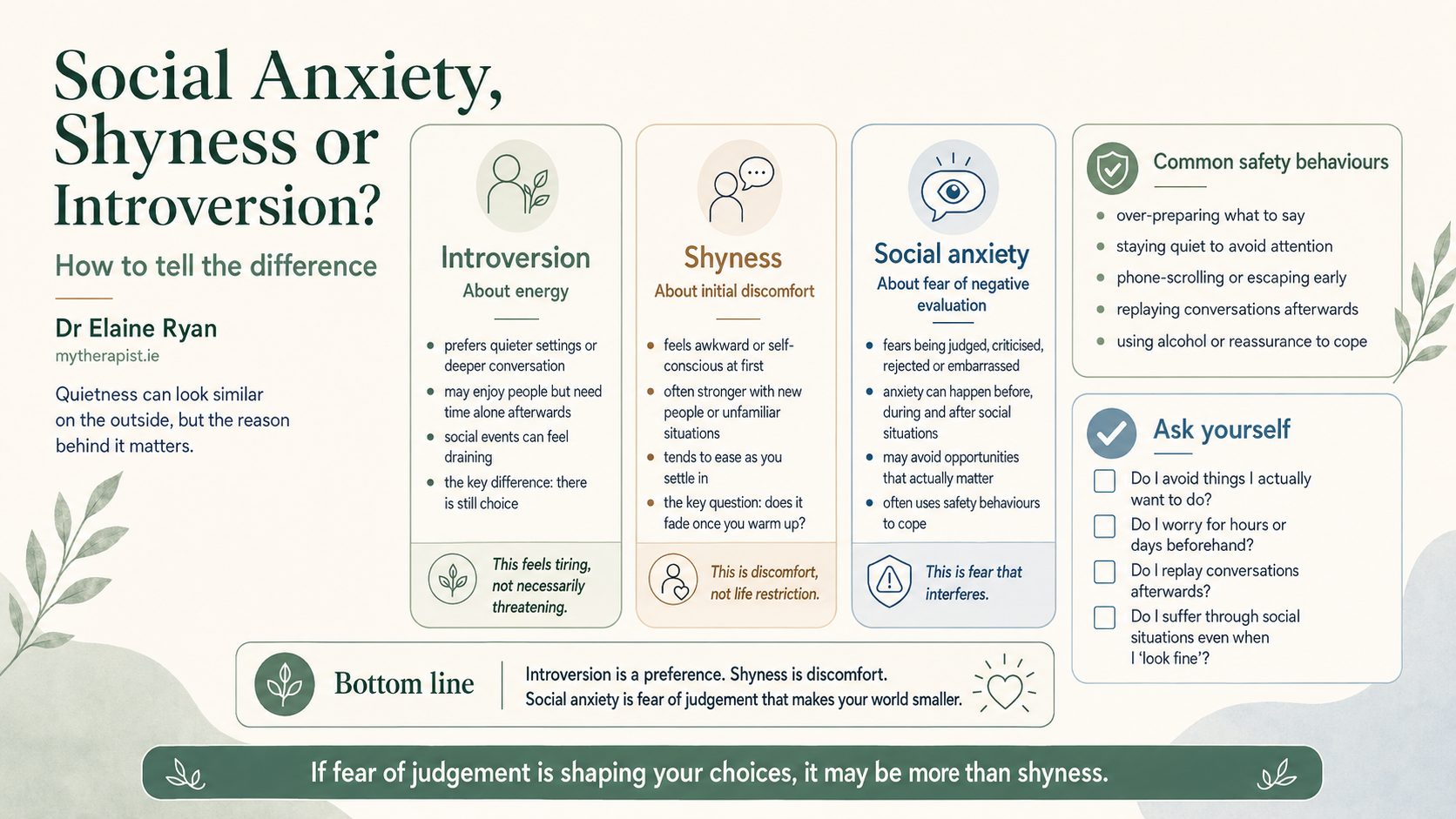
But social anxiety is different. It is not a preference for quiet. It is a fear response that limits your life.
Introversion is about energy
Introversion is not a diagnosis. It is a temperament. If you are introverted, you may enjoy people but need time alone afterwards. You may prefer deeper conversations to groups. You may like a quiet weekend more than a packed one.
There is nothing wrong with that.
The key point is choice. An introverted person can often choose to attend a social event, speak in a meeting, or meet someone new if it matters to them, even if they prefer not to do it all the time.
They may think, “This will be tiring,” but not necessarily, “This will be humiliating.”
Shyness is about initial discomfort
Shyness usually involves feeling nervous or self-conscious, especially with new people or unfamiliar situations. It may soften as you settle in.
A shy person might feel awkward at the start of a dinner, but after a while they warm up. They may dislike being the centre of attention, but the fear does not dominate their week.
Again, the key question is: does it stop you living the life you want?
Social anxiety is about fear of negative evaluation
Social anxiety is more than being quiet. It involves a fear of being judged, criticised, humiliated, rejected or exposed. The anxiety can happen before, during and after social situations.
You may worry before an event, monitor yourself during it, and replay it afterwards. You may avoid things that matter to you because the fear feels too strong.
The HSE notes that social anxiety can affect everyday activities, self-confidence, relationships, work and school life. That is the difference I want you to notice. Social anxiety is not just discomfort. It interferes.
A simple way to tell the difference
Ask yourself these questions.
Do I avoid things I actually want to do?
Do I spend hours or days worrying before ordinary social situations?
Do I replay conversations afterwards and criticise myself?
Do I use alcohol, over-preparation, silence, phone-scrolling or escaping early to cope?
Do I feel anxious when people watch me eat, write, speak, walk, shop, pay, sign something, or make a phone call?
Have I turned down work, college, friendships, dating, hobbies or opportunities because of fear of judgement?
If you answer yes to several of these, it may be more than shyness.
The “I can do it, but I suffer for it” group
There is another group of people who are often missed.
They do not look avoidant from the outside. They have jobs, relationships, and social lives. They attend meetings and answer emails. They may even be seen as competent.
But internally they are working extremely hard.
They script what they are going to say. They check their face. They mentally rehearse. They apologise too much. They say yes when they want to say no. They leave events exhausted and spend the night going over everything they said.
Because they are functioning, they tell themselves they do not deserve help.
I would disagree with that. Functioning is not the same as being well. If your life looks fine but costs you enormous anxiety, that still matters.
When low confidence is not the full explanation
Low confidence and social anxiety overlap, but they are not identical.
Low confidence might sound like, “I’m not sure I’m good at this.”
Social anxiety often sounds like, “If they notice I’m anxious, they’ll think I’m ridiculous, and I won’t be able to cope.”
Social anxiety has a threat quality to it. The mind predicts danger in ordinary social moments.
It might be danger of embarrassment, rejection, being trapped in a conversation, being watched, being judged as boring, or not knowing what to say.
The body then responds as if that danger is real. Heart racing, shaking, sweating, dry mouth, nausea, blank mind. This can make you even more self-conscious, which makes the anxiety louder.
Why labels matter, but not too much
It can be helpful to name social anxiety because it tells you there is a known pattern and there are treatments that can help.
But do not get stuck trying to diagnose yourself perfectly from an article. The practical question is:
Is fear of judgement making my world smaller?
If the answer is yes, you can start working on it.
Try this small exercise
Write down three columns.
- Column 1: situations I avoid.
- Column 2: situations I get through but suffer before or after.
- Column 3: situations I would like to do more freely.
Do not make this a harsh exercise. It is not a list of failures. It is a map.
For example:
• Avoid: work lunches, phone calls, dating apps, speaking in tutorials.
• Get through but suffer: meetings, family gatherings, hairdresser appointments.
• Want more freedom with: making friends, saying no, asking questions, being seen.
Now choose one small situation from column 2 or 3. Not the hardest one. One you can practise.
Your first goal is not confidence. Your first goal is contact with the situation without using all your usual safety behaviours.
When to get help
If social fear is affecting your day-to-day life, relationships, work, education, mood or choices, it is reasonable to seek help for social anxiety. Your GP, a psychologist, CBT therapist or other qualified mental health professional can assess what is happening.
You do not have to wait until your life collapses. In fact, it is better not to.
Social anxiety often convinces people that they are “just like this.” But if you have slowly built your life around avoiding embarrassment, judgement or exposure, that is not personality. That is a pattern. And patterns can change.