
Some anger is really a defence against the feeling of being judged.
Someone says:
“You forgot to do that.” “That hurt me.” “You were a bit sharp earlier.” “This work needs changing.” “Can you not speak to me like that?”
And suddenly your body reacts as if you are under attack. You interrupt. You explain. You criticise them back. You list all the things they do wrong. Or you go cold and silent.
In my experience working with couples ( not just anger ) I can see the confusion of both sides. An argument 9 times out of 10 starts, as the person feels criticised and the other person ends up defending themselves, explaining what they said, and often gets angry themselves. I always say in session and saying here, that people do the best they can with what they have available, and in this instance, even though it can be hard to understand why someone got angry, they are doing their best with their current understanding of the situation.
If this is something you recognise, afterwards you may think, “Why did I get so angry? They were only saying how they felt.”
This is anger triggered by criticism, and it is very workable once you understand the chain, which is what we shall look at today in this article. You may also find it helpful to identify your other anger triggers.
Why criticism can feel so threatening
Criticism is not just information when it lands on a sensitive place.
It can feel like: I am failing. I am not respected. I am being controlled. I am being exposed. I am not good enough. They think I’m useless. I am going to be rejected.
If you have a history of harsh criticism, bullying, shaming, unpredictable parents, perfectionism, or being made to feel “never good enough,” even mild feedback can hit the old alarm system.
Your anger then tries to protect you from shame.
Unfortunately, the protection often causes more damage than the criticism.
The defensiveness chain
It usually goes like this: Feedback arrives. Your body tightens. Your mind translates feedback into threat. Shame or fear appears. Anger covers it quickly. You defend, attack, dismiss or withdraw. The other person feels unheard. The conflict grows. You feel justified or ashamed. The next piece of feedback feels even more dangerous.
The goal is to insert a pause between feedback and defence.
The phrase I want you to practise
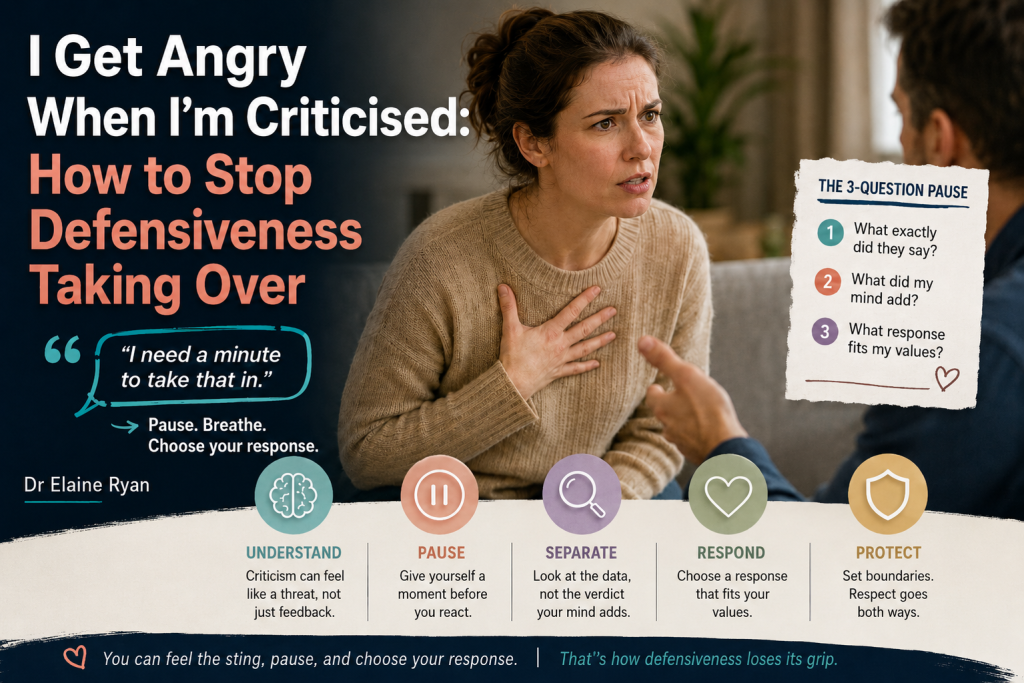
“I need a minute to take that in.”
That sentence is simple, but powerful. It stops the automatic reaction without pretending you are fine.
Use it at work. Use it with your partner. Use it with family. Use it when you feel your chest tighten.
You can also say: “I’m noticing I’m getting defensive. I want to respond properly.” “I’m finding that hard to hear, but I’m listening.” “Can you say the main point again more slowly?” “I want to understand before I answer.”
These are anger management skills in real language.
Separate data from verdict
When criticised, the angry brain hears a verdict.
“You forgot the appointment” becomes “you are useless.” “You sounded annoyed” becomes “you are a horrible person.” “This needs editing” becomes “you are incompetent.”
Try separating the data from the verdict.
Data: “I forgot the appointment.” Verdict: “I am useless.”
Data: “My partner felt hurt by my tone.” Verdict: “I am a bad partner.”
Data: “My manager wants changes.” Verdict: “I am failing.”
You can respond to data. You do not need to fight a verdict your own mind created.
The three-question pause
When you feel criticised, ask internally: What exactly did they say? What did my mind add? What response would fit my values?
For example: They said, “You were short with me earlier.” My mind added, “You’re attacking me and saying I’m awful.” Value response: “I can ask what they heard and apologise if needed.”
Or: They said, “This report needs changes.” My mind added, “I’m bad at my job.” Value response: “I can ask which sections need changing.”
This is CBT in practical form. You are not forcing positive thinking. You are checking the meaning your mind attached to the event.
Work on the pattern behind your reaction
If you want a structured way to practise, my self-paced anger management course covers triggers, judgements and assumptions, angry thoughts, and communication skills. It is for adults working on their own responses. You can explore the lessons and worksheets, including a preview, before deciding whether it suits you.
How to respond when the criticism is fair
Try: “You’re right. I did do that.” “I can see how that landed.” “I had not realised my tone came across that way.” “I’m sorry. I’ll try to say it differently next time.” “Thank you for telling me. I need to think about it.”
Short is better. Long explanations often become self-defence.
How to respond when the criticism is partly fair
Most criticism has a mixture of useful and unhelpful parts.
Try: “I agree with the part about me being late. I don’t agree that I don’t care. I do need to manage time better.”
Or: “I can hear that my tone was sharp. I also want us to talk about how we both handle these conversations.”
This allows accountability without accepting a global attack.
How to respond when the criticism is unfair
Anger often says, “Attack back.”
Try clarity instead.
“I don’t see it that way.” “I’m willing to discuss what happened, but I’m not willing to be called names.” “I can answer that if we keep it respectful.” “I need examples so I can understand what you mean.” “I’m going to pause this conversation if it continues in that tone.”
Boundaries are stronger than counter-attacks.
Practise with small feedback
Do not wait for the big emotional conversations. Practise with small things.
Someone corrects your pronunciation. Someone reminds you of a task. Someone suggests a different route. Someone says the dinner needs salt. Someone disagrees with your opinion.
Notice the tiny defensive impulse. Soften your body. Say, “Maybe.” Or, “Good point.” Or, “I’ll think about that.”
You are training your nervous system to survive feedback without fighting it.
If you grew up with harsh criticism
Be kind to the part of you that reacts quickly. It may have learned defensiveness for a reason. But also be honest: the people around you now should not have to pay for every old wound.
You can say: “I know I react badly to criticism. I’m working on it. If I say I need a minute, I’m not ignoring you. I’m trying not to snap.”
That gives people context without making them responsible for managing you.
When criticism becomes contempt or abuse
There is a difference between feedback and verbal abuse.
Feedback is specific and gives room for change. Abuse humiliates, controls, threatens or degrades.
“You forgot to call” is feedback. “You’re useless and nobody would put up with you” is not healthy feedback.
Anger management does not mean learning to tolerate being mistreated. It means learning to respond in a way that protects your safety, dignity and values.
Bottom line
If criticism makes you angry, the first task is not to become someone who enjoys criticism. The task is to stop your nervous system turning every correction into a threat.
You can feel the sting, pause, separate data from shame, and choose your response.
That is how defensiveness loses its grip.
Related reading: communication exercises for couples.