
If agoraphobia has made leaving home feel impossible, or almost impossible, the problem is not a lack of willpower. Your world has usually narrowed because your brain has learned, very powerfully, that home feels safer and moving beyond it feels dangerous.
I experienced something similar after several years of ill health, although in my case it was my health that initially kept me at home. As my health improved, I noticed that I was still finding it increasingly difficult to leave the house. When I did go out, I felt overstimulated by noise, traffic and people, which made me anxious and made me want to stay at home, where I felt safe. Something I had once taken for granted had become a big event. Years ago, I did not think about leaving the house; I simply did it. After being ill for so long, if I knew I had a hospital or GP appointment coming up, the anticipatory anxiety could begin weeks beforehand. Having personal experience of this, prompted me to write today’s article because getting help when you’re experiencing agoraphobia is very difficult.
This guide is for the practical starting point: how to begin agoraphobia recovery from home when getting to a GP surgery, therapy appointment or ordinary destination still feels out of reach. For a broader explanation of symptoms, causes and treatment, see my guide to agoraphobia.
Start from where you are: My Agoraphobia Course gives you short lessons and a workbook to help you plan small steps from home and build on what you learn.
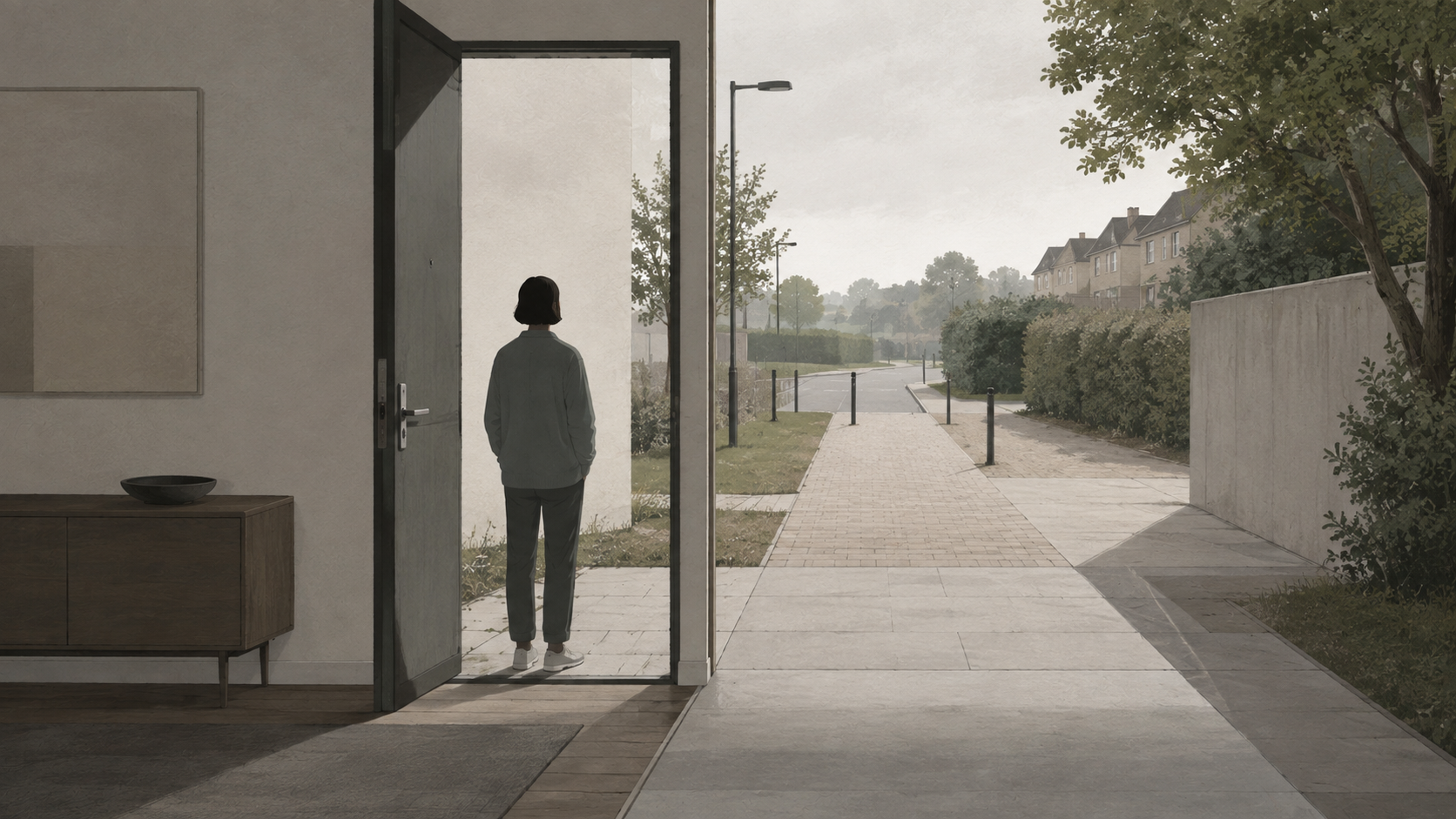
You do not have to begin by forcing yourself into a waiting room, onto a bus or into a busy shopping centre. You can begin from the chair, hallway, front door, garden step or parked car. The aim is not to prove that you are brave or to make anxiety disappear. It is to give the brain repeated opportunities to discover that you can approach the edge of your safe zone, experience anxiety and respond without immediately escaping.
First: check whether you need medical or urgent support
If you are housebound because of panic-like symptoms, it is still sensible to involve your GP, particularly if symptoms are new, severe, unusual for you or you are not sure they are anxiety. Chest pain, fainting, severe breathlessness, new neurological symptoms or a significant deterioration in your mental health need appropriate medical assessment.
If attending the surgery feels impossible, ask whether a phone or video consultation is available. You do not need a perfect explanation. A simple opening is:
“I think I may have agoraphobia. I am struggling to leave the house and I need advice about treatment options. Could I start with a phone or video appointment?”
You can also read my guide to how agoraphobia is diagnosed in Ireland.
Recovery can begin before you feel ready
A common trap is waiting for confidence before taking action: “When I feel less anxious, I’ll go outside.” In agoraphobia, confidence usually comes later. The first learning is that anxiety can rise and fall without every anxious moment ending in escape.
This does not mean starting with the worst situation. It means choosing something small enough to repeat.
- Stand inside the front door with your hand on the handle.
- Open the door for ten or thirty seconds.
- Sit by a window that faces the street.
- Step into the garden while leaving the door open.
- Stand in the hallway of an apartment block.
- Walk to the bin and back.
- Sit in the car without driving anywhere.
To someone without agoraphobia these steps may look tiny. To a nervous system that has learned “outside = danger”, they can be exactly the right size.
Make a safe-zone map before an exposure plan
Your agoraphobia recovery map
Home, bedroom, sofa, being home with another person
Doorway, garden, parked car, short walk, local shop with support
Public transport, motorway, supermarket alone, GP surgery, being far from home
Start at the edge between “safe now” and “difficult but possible”.
You do not begin in the most frightening zone.
For a fuller explanation of how to build this gradually, see my guide to graded exposure for agoraphobia. If you prefer something printable, you can also use my graded exposure worksheet for agoraphobia.
A realistic first week
Day 1: observe the pattern
Write down the places you avoid and, crucially, what you fear will happen. “Going out” is too broad. “I fear I will panic at the end of the street and not get back quickly enough” gives us something we can work with.
Day 2: choose one tiny edge
Pick one action that creates manageable anxiety rather than terror. Open the front door and stand there. Step outside and come back in. Stand at the gate. Sit in the parked car.
Day 3: repeat
Do not rush to make it harder. Repetition is part of the learning. The aim is not “I felt calm”; it is “I felt anxious and I stayed long enough to learn something.”
Day 4: reduce one safety behaviour
Notice what you use to feel safe: phone in hand, door kept open, another person beside you, pulse checking, water carried “just in case”, a carefully rehearsed escape plan. Do not remove everything at once. Reduce one behaviour slightly. For example, keep the phone in your pocket rather than in your hand.
Day 5: stay a little longer
If you stood outside for one minute, try one minute and thirty seconds. Small increases are enough.
Day 6: record what actually happened
Use three headings: What I feared, What actually happened, and What I learned. Anxious memory is selective; this helps you record coping and new learning rather than only the alarm.
Day 7: repeat, rather than prove
Do the same step again if that is what you need. Recovery is training, not a test.
What to do when panic rises
If panic rises during a step, try not to rush straight back to safety unless there is a genuine practical or medical reason. Give the panic wave some room to move by itself.
“This is panic. It is very uncomfortable. I do not need to solve it in the next 30 seconds.”
Let your shoulders drop. Allow breathing to settle rather than repeatedly testing or controlling it. Look outwards. Name what you can see and continue the task if you reasonably can. The important part is not forcing anxiety away; it is reducing the habit of treating anxiety itself as an emergency.
Use support without making another person the safety signal
A partner, friend or relative can be very useful when agoraphobia is severe. The long-term aim, however, is not for that person to become the reason you believe you are safe.
A helpful support person might say, “I’ll come with you to the gate. We’ll stay for two minutes. I won’t keep checking whether you’re okay every ten seconds.”
A less helpful pattern is, “Tell me the second you feel anxious and I’ll get you straight back inside.” It is well meant, but it can teach the brain that the anxiety required rescue.
Getting help in Ireland when leaving home is difficult
Your GP is usually a sensible starting point. Depending on your circumstances, options may include GP review, medication where appropriate, psychological therapy, guided self-help or online support. If you need help working out the pathway, see how to get help for anxiety in Ireland.
If panic attacks are the main reason your world has narrowed—for example, you avoid places because you fear another attack, watch your body for symptoms, plan escape routes or need to stay close to somewhere that feels safe—panic-focused CBT can be a useful part of the recovery plan.
Your first goal is not “normal life”
When you are housebound, “normal life” can be too distant to make a useful first target. A better first target is:
“I am going to teach my brain that the edge of my safe zone is not as dangerous as it feels.”
That edge may be the front door, driveway, lift, garden or car. Start there. Repeat there. Learn there.
Agoraphobia shrinks life through repetition. Recovery widens it through repeated new learning.
When you are ready for a next step, try the first few minutes outside. If being alone at home is part of the fear, read a gentle plan for being alone. If reaching an appointment is difficult, my GP contact script gives you words to start from home.
Sources and further reading
- HSE: Agoraphobia treatment
- HSE: Agoraphobia diagnosis
- NICE CG113: Generalised anxiety disorder and panic disorder in adults
This article is educational and is not a diagnosis or a substitute for individual medical or psychological advice.