
I think we all know there is no such thing as the perfect partner, but in relationships, I know this certainly happened with me, we grow to love, or at least accept, what we perceive to be flaws.
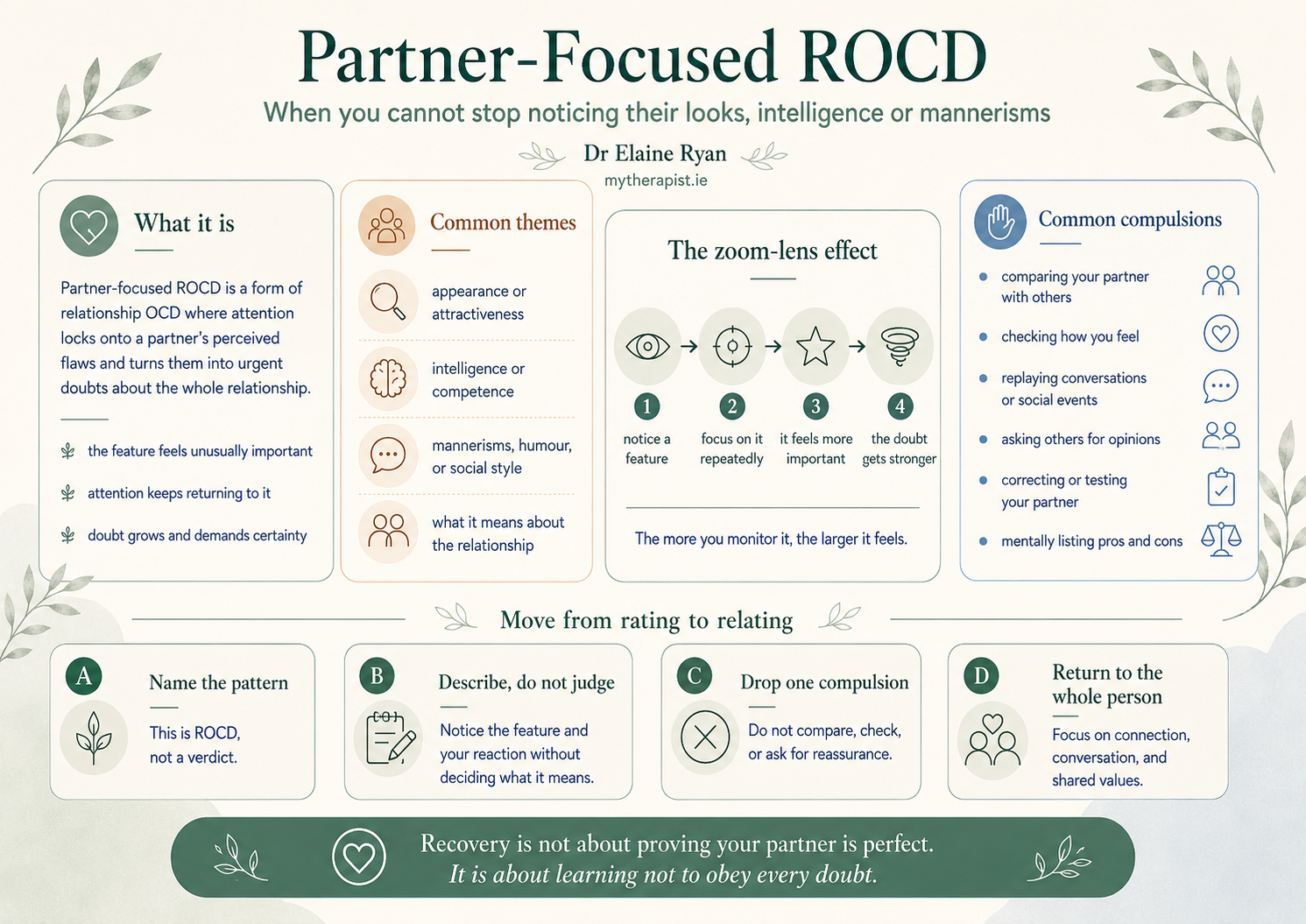
Sometimes one feature has taken over your attention, in an obsessive way.
Perhaps it is their teeth, height, laugh or posture. Maybe you’re hyper-focused with their intelligence, career, confidence, social skills or the way they tell a story ( I used to cringe (more than cringe to be honest) when an ex partner pretended to double over, with his arm across his belly pretending to laugh when he told a story). And you notice the feature every time you look at them. You compare it with other people. You try to remember whether it bothered you at the beginning.
Before you know it you question the validity of your relationship
“Would I be this focused on it if they were right for me?”
Partner-focused relationship OCD is not simply noticing that a partner has limitations. Everyone does. It is a repetitive obsessional process in which a perceived flaw becomes loaded with meaning and followed by checking, comparing, correcting or reassurance.
That’s the main difference between being bothered by their perceived flaw and wading into obsessive compulsive territory – if you notice it, and then begin to check, compare or get reassurance; these are compulsions and if you already recognise this in yourself, that deep deep doubt about your relationship or your partner’s flaws is possibly a symptom of OCD as opposed to a reason to break up with your partner, which is in itself another symptom of OCD, and you can read about ROCD and break up urges here.
Research and clinical descriptions of relationship OCD commonly distinguish relationship-centred symptoms—doubts about love or whether the relationship is right—from partner-focused symptoms. The latter may centre on appearance, sociability, intelligence or competence, morality, emotional stability and other personal qualities.
The two forms often feed one another:
“Their laugh irritates me.”
“If it irritates me, I may not accept them.”
“If I cannot accept them, this cannot be real love.”
“If it is not real love, I must leave before I waste more time.”
Within minutes, one laugh has become a judgement on the whole future.
The problem is not that you saw a flaw
I want to be precise here. Treatment is not about persuading you that the feature is attractive, that your partner is secretly brilliant, or that every concern is imaginary.
Your partner may genuinely be shorter than you once pictured. They may be quieter at parties than you. They may make jokes you do not enjoy. They may lack a skill that matters to you.
The OCD process begins when the mind insists that you must establish the exact significance of the feature before you can relax or commit.
You start asking:
- “How unattractive is it, from one to ten?”
- “Would other people notice?”
- “Am I embarrassed beside them?”
- “What does it say about me that I chose them?”
- “Could I tolerate this for forty years?”
- “Would a more intelligent partner make me happier?”
- “What if I am settling?”
Each question sounds as though it is gathering information. In practice, the information never becomes enough. The standard shifts and the assessment begins again.
This is the important distinction: ordinary evaluation helps you make a decision and then releases your attention. Obsessional evaluation keeps demanding another measurement.
The zoom-lens effect
Imagine taking a close-up photograph of one small mark on a painted wall. At that distance the mark fills the image. You can inspect every edge and shade. What disappears is the room.
Partner-focused ROCD does something similar with attention. Repeated monitoring increases the prominence of the feature. Because it is prominent, it feels important. Because it feels important, you monitor it more.
The person can move from relating to rating.
Relating means listening, responding, disagreeing, laughing, sharing work, repairing conflict and seeing a whole person in context.
Rating means silently scoring appearance, wit, grammar, ambition, warmth, confidence or social performance. Even an enjoyable evening can be lost because part of your attention is watching your partner and another part is watching your own reaction.
This also explains why trying harder to “see the good” can backfire. If you stare at a photograph and list ten attractive qualities to cancel one disliked feature, you are still treating attraction as an exam. Positive evidence can become reassurance rather than appreciation.
Compulsions that hide inside ordinary behaviour
Partner-focused compulsions can be subtle:
- positioning your partner beside someone else to compare height or appearance;
- watching how friends react to them;
- repeatedly showing photographs to people and asking for opinions;
- searching celebrities or former partners for a better match;
- testing their knowledge with questions;
- correcting words, clothes, posture or social behaviour;
- replaying a gathering to assess how they came across;
- imagining introducing them to someone you admire and monitoring shame;
- looking at them from different angles;
- avoiding eye contact or photographs because you fear noticing the feature;
- mentally listing compensating strengths;
- asking, “Would you leave someone because of this?”
Some of these behaviours may look like attempts to improve the relationship. Their function tells you more than their appearance. Are you addressing a specific, negotiable behaviour once—or trying to eliminate uncertainty about the partner’s overall adequacy?
Comparing your relationship with other couples and social media explores the comparison process in more detail.
Move from judgement to description
A useful first exercise is to remove the verdict from your language.
Instead of:
“His laugh is unbearable and proves we are incompatible.”
Try:
“I notice a loud laugh. I feel irritation and an urge to decide what it means.”
Instead of:
“She is not intelligent enough for me.”
Try:
“We have different knowledge and communication styles. My mind is asking me to rank her intelligence globally.”
Description does not force approval. It separates an observable feature, your reaction, and the OCD demand for a conclusion.
Then ask:
“What would relating look like for the next ten minutes?”
It might mean listening to the story rather than evaluating its delivery. It might mean allowing your partner to choose their clothes. It might mean going to the gathering without monitoring other people’s faces. It might mean letting irritation be present without correcting the mannerism.
The task is not to manufacture affection. It is to stop making continuous assessment the price of participation.
Build an imperfection hierarchy
ERP for partner-focused ROCD involves planned contact with uncertainty and imperfection while reducing the response that usually follows. It is not an exercise in humiliating your partner or pretending genuine problems do not exist.
Create a graded list from manageable to difficult. Examples might include:
- Allowing a mildly irritating phrase to pass without correcting it.
- Looking at one ordinary photograph once, without zooming or comparing.
- Going for coffee without checking whether you feel proud to be seen together.
- Letting your partner speak at a social event without monitoring others’ reactions.
- Wearing or displaying a photograph you do not consider perfect.
- Writing and reading: “My partner has qualities I dislike, and I may never know exactly how much they should matter.”
- Spending time with a person you tend to use as a comparison, without ranking either partner.
Choose one response to prevent. Do not correct. Do not compare afterwards. Do not ask for reassurance. Do not review whether the exercise made the feature seem better or worse.
That last part is important. If you finish an exposure and immediately ask, “Am I less bothered now?”, the rating system remains in charge.
A clinician who understands CBT with ERP can help tailor this work, particularly where shame, depression, body-image concerns or other OCD themes are involved.
When a quality really matters to you
Having ROCD does not remove your preferences or values. Some differences matter greatly in a relationship. The aim is not unconditional acceptance of every behaviour.
Move from global labels to specific patterns:
- “They are immoral” is global. “They repeatedly lie about money and refuse to discuss it” is specific.
- “They are socially embarrassing” is global. “They mock me in front of friends after I ask them to stop” is specific.
- “They are not ambitious enough” is global. “We want incompatible financial and working lives and cannot find a workable agreement” is specific.
Specific issues can be discussed, negotiated or acted upon. Global ranking tends to produce endless mental trials.
Also ask whether the standard is reciprocal and human. Would any real person be allowed ordinary awkwardness, ageing, mistakes and areas of weakness? Or does the mind require a partner who protects you from regret, judgement and every awareness of alternatives?
You may eventually decide that a difference is too important. ERP does not forbid that. It helps reduce the compulsive noise so the choice is less about obtaining a flawless guarantee.
Partner-focused ROCD can make a loved person feel like an object under inspection and can leave both people hurt. Change begins when you stop trying to win the argument about the flaw and start changing the behaviour around it.
Notice the zoom. Name the rating. Prevent one check. Return to the whole room.
References and further reading
- Doron, G., Derby, D. S., Szepsenwol, O. and Talmor, D. Flaws and all: Exploring partner-focused obsessive-compulsive symptoms.
- International OCD Foundation: Relationship OCD
- NICE: OCD and body dysmorphic disorder — treatment
- Doron, G. et al. Relationship obsessive-compulsive disorder: Interference, symptoms and maladaptive beliefs.