
Social anxiety, like all anxiety disorders can be understood and today, I want to break social anxiety down into manageable parts, as I have found with clients over the years that when they can see each part and how it connects to the bigger picture that is their social anxiety, that it helps immensely with their recovery.
If you haven’t already done so, I recommend you read my main guide to social anxiety. You can also read all my social anxiety articles here.
I want you think of social anxiety as an on-going cycle fuelled by anticipatory anxiety, internalised focus, and safety behaviours. Rather than being caused by negative experiences, the reason is keeps going is because it is often maintained by the coping mechanisms that you have developed to help you function, which inadvertently prevent the brain from learning that it can handle social uncertainty. I’m going to explain how post-event processing distorts memories, causing you to replay perceived failures and reinforce your fears. To step out of the cycle or loop, you need to shift your attention outward, intentionally dropping protective habits, and conducting objective reviews of social encounters. Ultimately, the goal is not to eliminate nervousness entirely, but to prove through small behavioural experiments ( which are part of CBT) that you can participate in life despite feeling anxious.
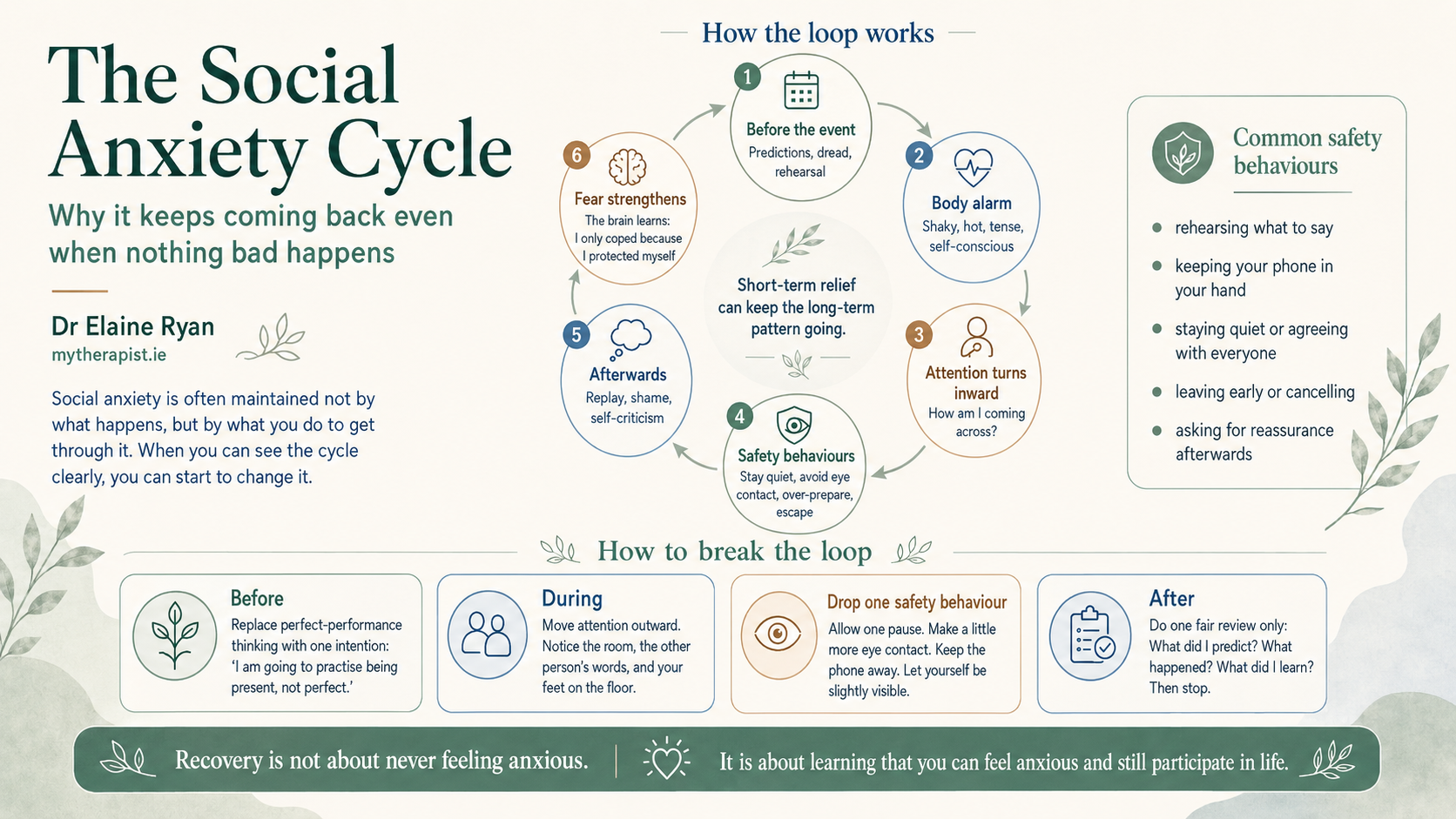
Social anxiety is often maintained not by what happens, but by what you do to get through it.
The cycle starts before the event
Social anxiety often begins before you have even left the house.
The mind starts predicting:
• I will go blank.
• They will see I am anxious.
• I will have nothing to say.
• I will blush.
• I will sound stupid.
• I will be trapped.
Your body hears those predictions as threat. Heart rate rises. Stomach turns. You may feel shaky or hot. Then the physical sensations become more evidence: “See, I can’t cope.”
You may start rehearsing. You plan what to say. You imagine escape routes. You check your appearance. You tell yourself you must not blush, shake, sweat, stumble, pause, or look nervous.
The event has not happened yet, but you have already lived through it several times in your head.
During the event, attention turns inward
This is one of the most important parts of social anxiety.
Instead of being fully in the conversation, your attention turns towards yourself.
How am I coming across?
Is my face red?
Did my voice sound strange?
Where are my hands?
Do they think I am boring?
The problem is that self-focused attention gives you poor information. You are trying to judge the room while looking mainly at yourself. You feel anxious inside, so you assume you look anxious outside. You feel awkward, so you assume others experience you as awkward.
This is why people with social anxiety often underestimate how well they came across.
Safety behaviours give short-term relief
Safety behaviours are the things you do to prevent embarrassment or reduce anxiety.
Some are obvious:
• Avoiding eye contact.
• Staying quiet.
• Cancelling.
• Leaving early.
• Drinking alcohol before socialising.
• Keeping your phone in your hand.
Others look like effort or politeness:
• Over-preparing every sentence.
• Asking lots of questions so nobody asks about you.
• Smiling constantly so you seem agreeable.
• Wearing clothes that hide sweating.
• Arriving late so there is less time to talk.
• Agreeing with everyone to avoid conflict.
The difficulty is that safety behaviours work in the moment. They lower anxiety. But they teach your brain the wrong lesson.
The lesson becomes: “I survived because I stayed quiet,” or “I survived because I escaped early,” or “I survived because I rehearsed for three hours.”
Your brain does not learn: “I could have coped anyway.”
Afterwards, the review begins
Many people think social anxiety ends when the social situation ends. Often, that is when the second part begins.
You get home and the mental replay starts.
Why did I say that?
Did they notice my hands shaking?
Was that silence my fault?
Did I talk too much?
Did I not talk enough?
You may replay the same moment repeatedly, each time feeling more certain that you made a fool of yourself. This is called post-event processing, and it is a powerful way to keep social anxiety alive.
The event becomes less like a real memory and more like an edited anxiety film, with every awkward moment zoomed in and everything neutral removed.
Why reassurance does not fix it
You might ask someone, “Did I seem weird?” They say no. You feel better for five minutes.
Then anxiety asks for more.
Are they just being kind?
Did they notice but not want to say?
What about the other person?
Reassurance can become another safety behaviour. It gives brief relief, but it does not teach your brain to tolerate uncertainty or trust your own ability to cope.
How to start breaking the cycle
You do not break the loop by giving yourself a motivational speech. You break it by changing the parts that maintain it.
Start before the event.
Instead of rehearsing the perfect performance, write one helpful intention:
I am going to practise being present, not perfect.
During the event, move attention outward.
Notice the colour of the walls, the tone of the other person’s voice, the words they are using, the feel of your feet on the floor. This is not a trick to remove anxiety. It is a way of gathering better information.
Drop one safety behaviour.
Not all of them. One.
Maybe you make a little more eye contact. Maybe you allow one pause. Maybe you do not over-explain. Maybe you keep the phone in your bag. Maybe you let your hands shake without hiding them.
Afterwards, do a fair review.
Not a positive review. A fair one.
Ask:
• What did I predict would happen?
• What actually happened?
• What safety behaviours did I use?
• What did I learn?
• What would I like to practise next time?
Do this once, in writing, for five minutes. Then stop. Returning to the review for another hour is not problem-solving. It is anxiety doing laps.
A small behavioural experiment
Choose one low-stakes social situation this week.
For example, saying hello to a neighbour, asking a shop assistant where something is, making a short phone call, asking one question in a meeting, or sending a message without rewriting it ten times.
Before you do it, write your prediction:
If I do this, I think…
Then do the situation while dropping one safety behaviour.
Afterwards, write what happened.
The point is not to prove that nothing awkward ever happens. Awkward things happen to everyone. The point is to teach your brain that awkwardness is survivable and that you do not need to live under constant protection.
The loop changes through practice
Social anxiety improves when your brain has repeated experiences of doing things differently.
Not perfectly. Differently.
Each time you face a situation with less self-protection, you give your brain new information. You are not trying to become someone who never feels anxious. You are becoming someone who can feel anxious and still participate in life.
Sources