
For most people, the first port of call to get help with Social Anxiety is their GP, but most people don’t know what to say or are too scared they shall make a fool of themselves that they never make the call. I’m going to help you with that today.
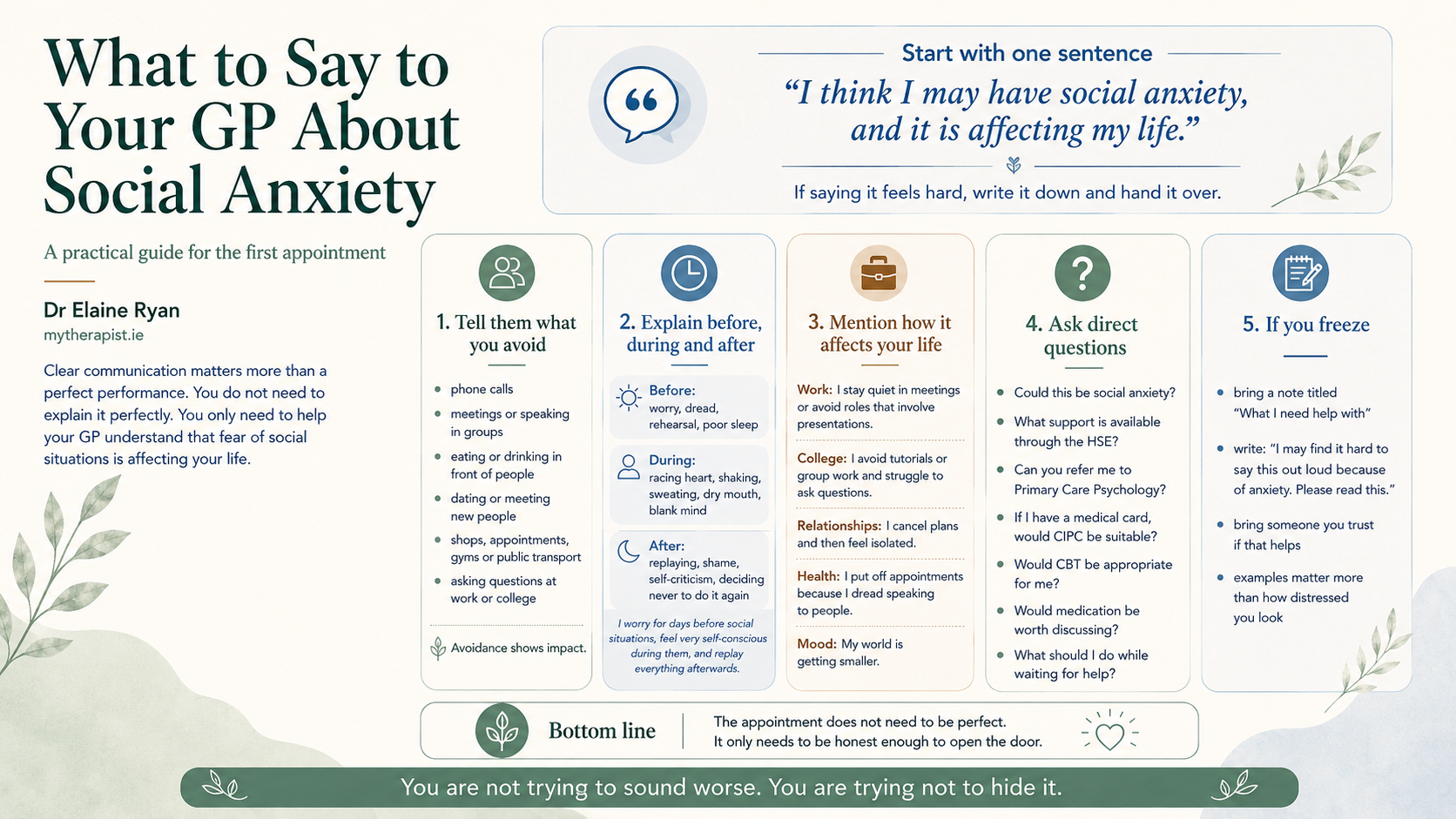
Clear communication is more important than a perfect performance during a doctor’s visit. To help your GP distinguish social anxiety from general nervousness, I shall give concrete examples to make sure you are understood, what questions to asks, how to ask them and ask about specific treatments such as Cognitive Behavioural Therapy and medication.
If you haven’t already done so, I recommend you read my main guide to social anxiety. You can also read all my social anxiety articles here.
If you have social anxiety, the idea of talking to your GP can feel like an exam you have not studied for.
You may worry you will sound dramatic. You may worry the GP will think you are wasting time. You may worry you will go blank, cry, minimise everything, or leave without saying the thing you came to say.
This article is here to help with that specific moment.
You do not need to explain social anxiety perfectly. You only need to give your GP enough information to understand that fear of social situations is affecting your life.
Start with one sentence
If you remember nothing else, use this:
I think I may have social anxiety, and it is affecting my life.
That is a perfectly reasonable opening sentence.
If you find it hard to say it, write it down and hand it over. Many people communicate better in writing when they are anxious.
Tell them what you avoid
GPs hear a lot of general anxiety descriptions, such as “I feel anxious all the time.” That is useful, but social anxiety is clearer when you describe what you avoid.
For example:
– I avoid phone calls.
– I avoid meetings or speaking in groups.
– I avoid eating or drinking in front of people.
– I avoid dating or meeting new people.
– I avoid shops, appointments, hairdressers, gyms or public transport because I feel watched.
– I avoid asking questions at work or college.
– I avoid social events and then feel lonely.
Avoidance shows impact. It helps the GP understand that this is not ordinary nervousness.
Tell them what happens before, during and after
Social anxiety is often a three-part problem.
Before: worry, dread, rehearsal, poor sleep, checking, planning escape.
During: racing heart, shaking, sweating, dry mouth, nausea, blank mind, self-consciousness.
After: replaying, shame, self-criticism, asking for reassurance, deciding never to do it again.
You might say:
I worry for days before social situations. During them I feel physically anxious and very self-conscious. Afterwards I replay everything and feel embarrassed even when nothing obvious happened.
This gives a much fuller picture than “I’m shy.”
Mention how it affects your life
A GP will want to know how much this is interfering with your day-to-day functioning.
Try to give concrete examples.
Work: “I don’t speak in meetings and I’ve avoided applying for roles that would involve presentations.”
College: “I avoid tutorials and group work. I’m falling behind because I cannot ask questions.”
Relationships: “I want friends, but I cancel plans and then feel isolated.”
Health: “I put off appointments because I dread speaking to reception or being examined.”
Mood: “I’m starting to feel low because my life has become very small.”
You are not trying to make it sound worse. You are trying not to hide it.
Ask direct questions
When you are anxious, it is easy to leave the appointment without asking what you needed to ask. Bring a short list.
Useful questions include:
– Do you think this could be social anxiety disorder?
– Are there any physical health issues or medications that could be contributing to my symptoms?
– What support is available through the HSE in my area?
– Can you refer me to Primary Care Psychology or another service?
– If I have a medical card, would Counselling in Primary Care be suitable?
– Would CBT be appropriate for me?
– Would medication be worth discussing, and what would the pros and cons be?
– What should I do while waiting for help?
You do not have to ask all of these. Pick the ones that apply.
If you freeze in the appointment
Freezing is common. Your mind goes blank because your threat system is activated.
Plan for that.
Bring a note titled “What I need help with.” Put the important points in bullet form. At the top, write:
I may find it hard to say this out loud because of anxiety. Please read this.
You can also bring someone you trust if that helps. They do not need to speak for you unless you want them to. Their job can simply be to sit beside you and help you stay in the room.
If the GP says it is anxiety
That may be correct, but you still want specificity.
You can say:
I understand it is anxiety, but it is mainly fear of social situations and judgement. Could we look at social anxiety specifically?
This matters because the treatment focus may differ. For social anxiety, CBT often works on self-focus, safety behaviours, avoidance, fear of negative evaluation and post-event rumination.
If medication is mentioned
Some people feel relieved when medication is discussed. Others feel frightened or ashamed. Neither reaction is wrong.
Medication can be one part of treatment for social anxiety, and your GP can talk you through whether it is suitable. The HSE notes that antidepressant medicine, usually an SSRI, may be prescribed for social anxiety. NICE recommends that medication decisions include discussion of benefits, side effects, early activation symptoms and monitoring.
Do not start, stop or change medication based on an article. Use the appointment to ask questions.
If you are worried you will not be believed
Many people with social anxiety appear composed. They may be articulate. They may smile. They may have a job. The GP may not see the hours of dread before the appointment or the collapse afterwards.
That is why examples matter.
Do not rely on how distressed you look in the room. Tell them what it costs you outside the room.
A ready-to-use note for your GP
You can copy this and adapt it.
I think I may have social anxiety. I avoid or dread social situations because I am afraid of being judged, embarrassed or seen as anxious. This affects my life in these ways: [write examples]. Before social situations I [worry/rehearse/cannot sleep]. During them I [shake/sweat/go blank/panic/feel watched]. Afterwards I replay what happened and criticise myself. I would like advice on assessment and treatment options, including CBT, HSE supports, and whether any medication or referral is appropriate.
That is enough.
Please ask even if you feel embarrassed
Your GP will have heard many versions of anxiety before. You are not the only person who has struggled to make the appointment, sat in the waiting room feeling exposed, or rehearsed the first sentence.
The appointment does not need to be perfect. It only needs to be honest enough to open the door.