
This happens to everyone and has happened to me in the middle of a session with a client, but when your mind goes blank and you have social anxiety it can feel like an interrogation going on inside your head.
You know how to speak. You may have had opinions and stories five minutes earlier. Then somebody looks at you, asks a simple question, and your mind leaves the building.
Social anxiety interprets the pause immediately: “This proves I am boring,” “They can see something is wrong,” or “I’ shall never recover’m never going to be able to get over this.” The attempt to force the correct sentence places even more pressure on the mental system that is already overloaded.
A blank mind in an anxious moment is often less about having no thoughts and more about where attention and working capacity have gone.
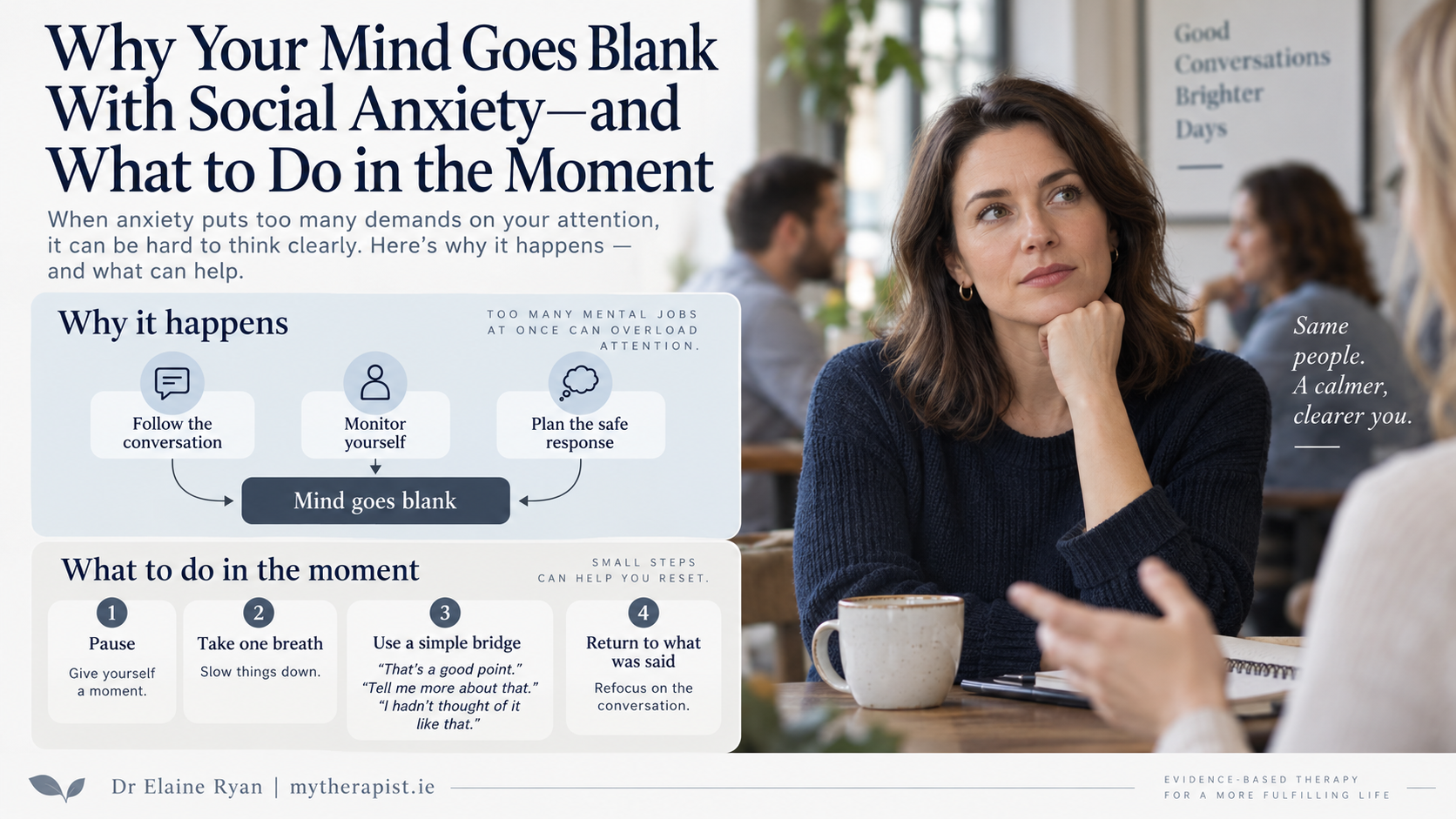
Your attention has been given three jobs at once
If you have been reading any of my other articles on social anxiety, you will notice that I talk a lot about attention and how much pressure is being placed on your brain to complete a task; this splitting of attention is also relevant here.
During an ordinary conversation, attention follows meaning: what was said, what you think about it and what comes next. During social anxiety, a large part of that attention is diverted into surveillance.
You listen while checking your face, planning the next sentence, judging the last one and predicting the other person’s verdict. You may also issue commands—“Say something now,” “Do not pause,” “Sound normal.” There is less capacity left for spontaneous recall and response.
This is one part of the social anxiety cycle: attention moves inward, the interaction becomes harder to follow, and the difficulty can then be misread as evidence that you are socially failing.
- Task one: follow the other person’s words.
- Task two: monitor how you look and sound.
- Task three: construct and inspect a safe response before speaking.
The feared meaning of the pause keeps the blank going
A pause is not objectively the same as humiliation. It becomes threatening when you predict that another person will treat it as evidence of stupidity, incompetence or social failure.
Once that prediction is active, you search for the perfect rescue sentence. Each rejected sentence confirms that the situation is urgent. The blank is no longer a moment in conversation; it is an emergency you believe must be hidden.
I would therefore ask two questions: What do you think the pause tells the other person? What do you do to prevent them reaching that conclusion?
If blanking has made you avoid conversations
My self-paced Social Anxiety Course helps you map the prediction, self-monitoring, safety behaviours and avoidance around difficult interactions. The work is designed to produce new learning, not a supply of perfect scripts.
It is general self-help for adults and cannot assess new or unexplained memory symptoms.
What to do when the blank happens
These phrases are not magic scripts. Use one if it helps you remain in contact, then let it be imperfect. If you memorise ten rescue lines and inspect which one sounds safest, the rescue system becomes another burden.
- Stop searching for the best sentence and return to the last thing you heard.
- Allow one breath without checking whether the pause looks strange.
- Use a simple truthful bridge: “Give me a second,” “I lost my train of thought,” or “What was the last part?”
- Ask about the meaning of what was said rather than producing an impressive new topic.
- Continue without apologising repeatedly or explaining the anxiety in detail.
Practise recovering, not preventing
A good behavioural experiment allows a small pause rather than arranging the situation so no pause can occur. Use my social-anxiety exposure method to state the prediction and reduce one protection.
| Usual protection | Practice change | Learning question |
|---|---|---|
| Rehearse every answer | Prepare only the factual point | Could I form ordinary words in the room? |
| Speak immediately | Allow two seconds before answering | Did the pause end the interaction? |
| Fill every silence | Let the other person share responsibility | Did conversation restart without rescue? |
| Apologise for going blank | Use one neutral bridge and continue | Was a long explanation necessary? |
Do not grade the conversation from inside your body
An internal feeling of blankness does not reveal how the interaction appeared. A two-second pause can feel much longer when attention is magnified. The other person may see thinking, distraction or an entirely normal break.
Afterwards, separate observable information from anxious reconstruction. If the review continues, use the post-event review method rather than replaying until the conversation feels safe.
When to discuss blank spells with a doctor
Anxiety can affect concentration, but not every episode of confusion or memory difficulty should be assigned to anxiety. Speak to your GP if blank spells are new, occur outside stressful situations, are accompanied by fainting, disorientation, neurological symptoms or medication changes, or are affecting daily functioning more broadly.
The social-anxiety pattern is usually situation-linked and organised around scrutiny. A clinician can consider the wider context.
One experiment for this week
Choose a short conversation with a familiar person. Prepare no rescue topics. Your task is to follow what they say and permit one natural pause before responding. If your mind blanks, use one plain bridge and remain in the interaction.
Record whether the feared consequence occurred—not whether the conversation felt effortless.