
The conversation is over, but it is being pulled apart and rehashed in your mind. You feel all the same feelings and some may be stronger as you relive what happened, maybe even adding bits on, that you should have said or done.
You hear your sentence again. You inspect the pause before the other person answered. You try to reconstruct their expression and decide whether you talked too much, too little or sounded odd. Each replay feels as if it might finally tell you what they thought. Instead, you usually become less certain and more ashamed.
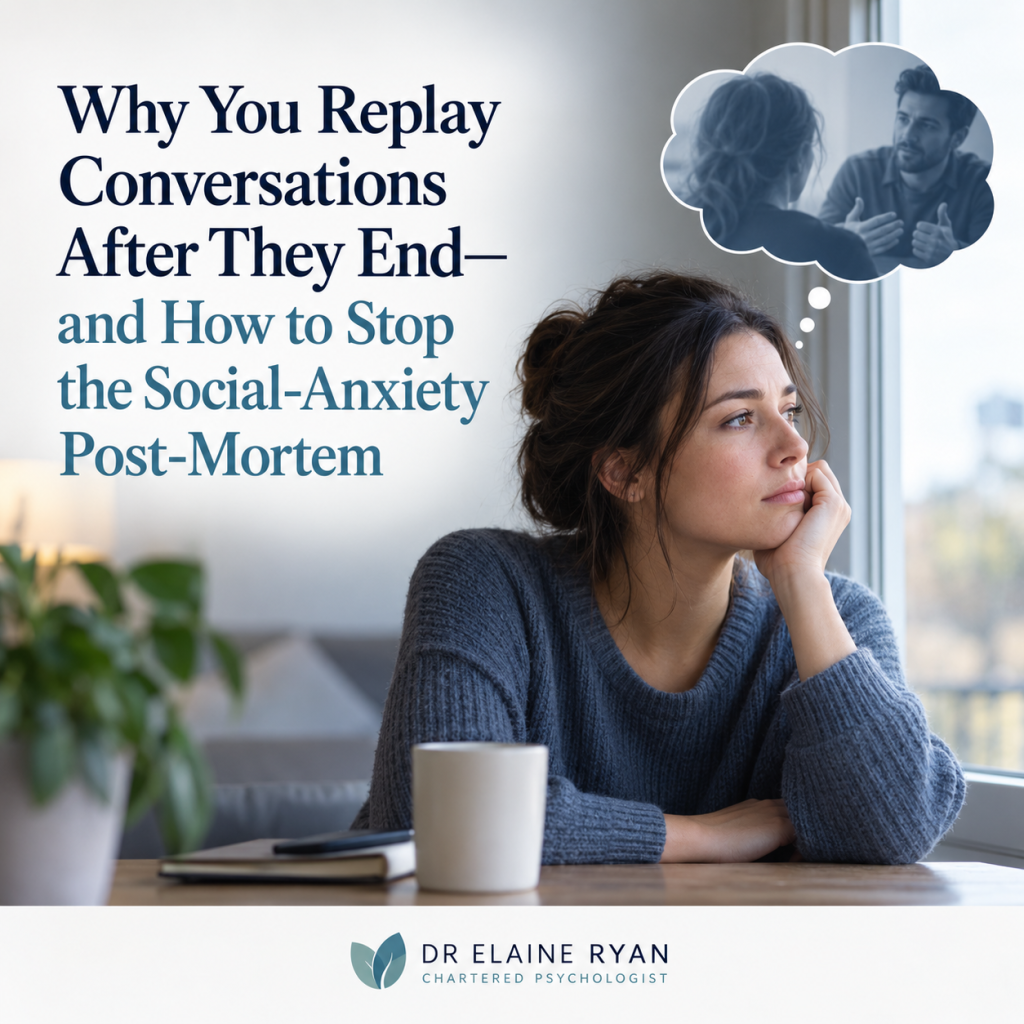
In social anxiety this is called post-event processing or post-event rumination. It is not merely remembering a conversation. It is a threat-focused review which tries to remove uncertainty after the social situation has ended.
Reflection and an anxious post-mortem are different
Useful reflection is limited and has a purpose. You notice that you interrupted someone, decide to apologise, and then move on. An anxious post-mortem has no natural finishing point because it is trying to answer a question you cannot answer with certainty: “What did everybody think of me?”
| Useful reflection | Post-event processing |
|---|---|
| Uses observable information | Uses anxious feelings as evidence |
| Identifies a specific action, if one is needed | Searches repeatedly for hidden mistakes |
| Allows ordinary uncertainty | Demands certainty about another person’s opinion |
| Stops when the question has been addressed | Creates another question after every answer |
The difference matters. Telling yourself never to reflect would be neither realistic nor helpful. The task is to recognise when reflection has stopped producing information and anxiety has taken over the investigation. I used to be guilty of this myself quite a lot, and a quick rule of thumb I use is, if the thoughts pop into my head and I find myself thinking about them without much conscious awareness of when it started or how long I have been thinking about it, I know it is rumination and I need to stop. My body lets me know I need to stop as we never deviate this amount of analysis to things that make us feel good in our body.
Why the replay feels so convincing
During the original conversation, part of your attention may have been fixed on yourself. You noticed heat in your face, tightness in your throat or the effort involved in finding a word. Afterwards, the mind uses those sensations to construct an image of how you must have appeared.
“I felt painfully conspicuous” becomes “I looked painfully conspicuous.” “I struggled to concentrate” becomes “I made no sense.” The memory is treated like a recording, but it contains anxious interpretation.
The review is also selective. A brief pause is examined in detail while the other person’s friendly answer is dismissed. A neutral expression becomes disapproval. Evidence that the interaction was ordinary is labelled politeness, so it cannot correct the feared belief.
If the review is keeping social anxiety alive
My self-paced Social Anxiety Course helps you map what happens before, during and after social situations, then work on the CBT processes that keep the fear going. That includes self-focused attention, predictions, avoidance, exposure and the way anxious memory can shape the next encounter.
How replaying maintains the next anxious event
Post-event processing does not remain in the past. It writes the prediction for next time.
- You remember the last interaction as worse than it was.
- You predict that the same embarrassment will happen again.
- You prepare more, monitor yourself more closely or avoid the next situation.
- Those protective behaviours make it harder to be present and prevent new learning.
- Afterwards, you review again.
This is one part of the wider social-anxiety cycle. The replay feels like preparation, but it keeps the social event marked as dangerous.
A four-question objective review
If something is genuinely bothering you, give the review a clear structure and an ending. Write brief answers to these four questions once.
- What did I predict beforehand? Use the actual prediction, not “it would be bad.”
- What could a camera or microphone have recorded? Include evidence that does not fit the anxious account.
- Am I confusing what I felt with what other people observed? Feeling foolish does not establish that you appeared foolish.
- Is there one proportionate action to take? If you clearly hurt someone, repair it. If you are trying to obtain certainty that you were acceptable, recognise the reassurance trap.
Then stop the formal review. Stopping does not mean proving the conversation was perfect. It means refusing to spend another hour trying to know the unknowable.
What to do when the mind starts again
The thought may return five minutes later: “Yes, but what about the way they looked at me?” You do not need a new analysis. Name the process accurately:
“This is the social-anxiety review starting again. I have checked the useful facts. I can allow the remaining uncertainty.”
Return to what you intended to do next. This is not distraction used to suppress a thought. The thought is allowed to be present; you are choosing not to turn it into another investigation.
If you usually ask someone, “Did I seem weird?” delay the question. Notice the urge for reassurance and let it rise and fall without obeying it straight away. Reassurance can provide short relief while teaching the brain that your own uncertainty was unsafe. I explain that pattern further in why reassurance only helps anxiety briefly.
Do not use the review to demand perfection
An objective review is not a gentler way to insist that you made no mistake. You may have talked over somebody. Your joke may not have landed. You may have looked anxious. The corrective lesson is not “I always come across well.”
A more honest lesson is that ordinary social contact contains pauses, misjudgements and mixed opinions. You can notice a real mistake, make a proportionate repair where needed, and continue with your day without turning one moment into a verdict on you.
A small behavioural experiment
After your next manageable social interaction, predict how long you expect to replay it. Then postpone the review for thirty minutes. During that time, carry on with a normal activity without checking messages, facial expressions or another person’s opinion.
When the thirty minutes ends, ask whether there is a specific, observable problem that requires action. If not, postpone again. The experiment is not about forcing the thoughts away. You are discovering whether the urge to analyse can change without being satisfied.
If you want a broader explanation of repetitive thinking, see my article on rumination and anxiety. For practical help with the worry that builds before an interaction, read my guide to anticipatory anxiety.
When to seek more help
Speak to your GP or a qualified mental health professional if the replaying is consuming large parts of your day, stopping you from sleeping or working, driving serious avoidance, or occurring alongside depression, compulsive checking or thoughts of harming yourself. If you are in Ireland and the first call feels difficult, my guide to getting help for social anxiety in Ireland explains the available routes. Replaying conversations can occur in several difficulties; an article cannot tell you what it means in your case.