
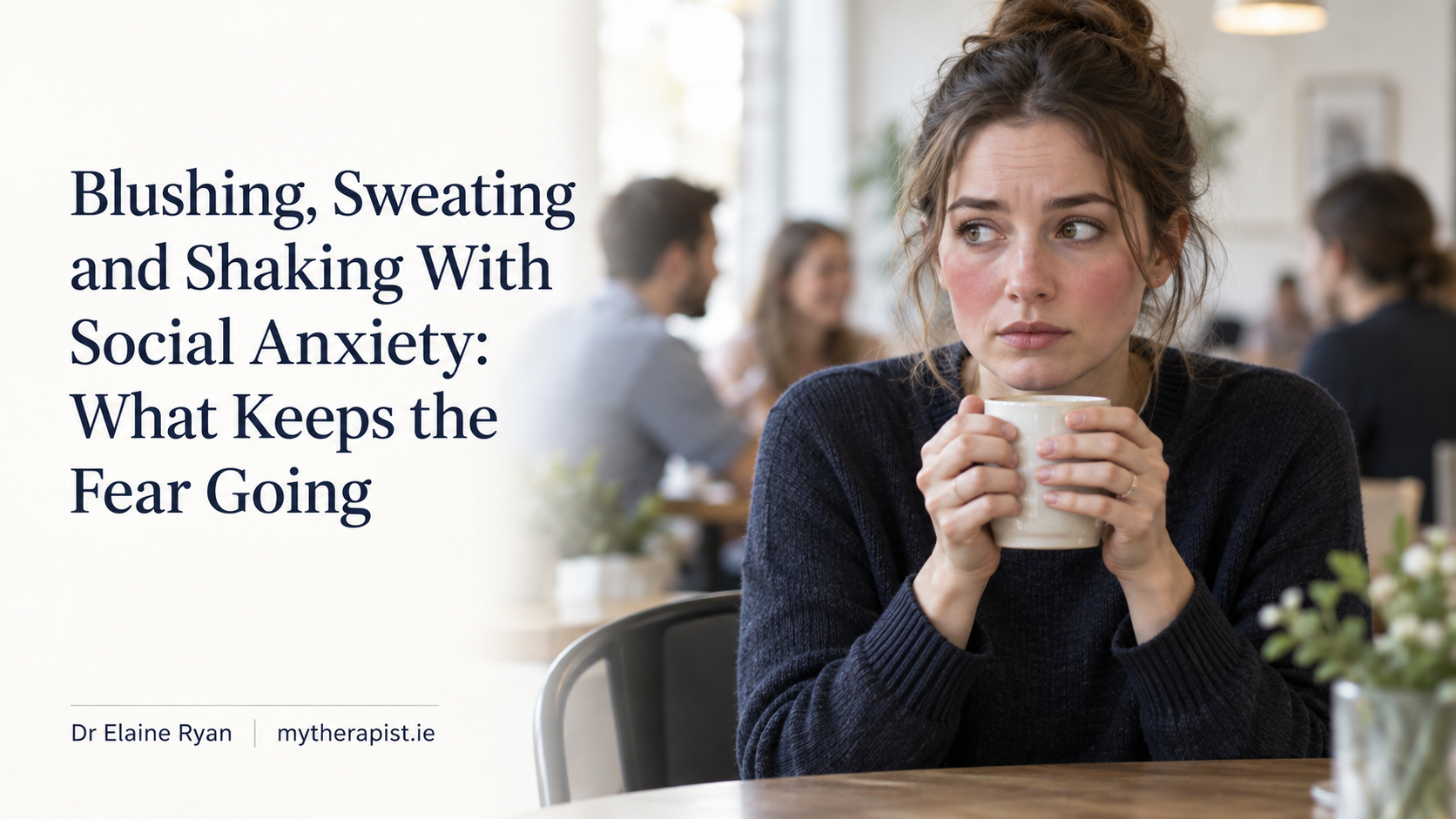
For some people, the most frightening part of social anxiety is not the conversation, meeting or meal. It’s what your body might do during the interaction; you might be terrified that your face will be bright red, that you’ll sweat or shake, or present someone with a clammy hand. It’s like your body announces: “Everybody can see that I am not coping.”
This creates two fears at once. There is the original social situation, and there is the fear of having a visible symptom inside it. The second fear often becomes the more powerful one because you cannot completely control a living body.
The aim of treatment is not to guarantee that you will never blush, sweat or shake. It is to change the meaning you attach to the symptom and the things you do to prevent other people noticing. That is where the social-anxiety cycle can be interrupted.
The symptom is uncomfortable; the predicted meaning creates the threat
If you were in session with me, I formulate this problem, by asking what you believe the symptom will communicate. “My face will become warm” is a description. “They will think I am weak, dishonest, attracted to them, incompetent or strange” is the feared meaning.
Two people can have the same physical response and need different experiments because the predicted social consequence is different. Unless you identify that consequence, you may spend all your energy trying to cool the face or steady the hand while the central belief remains untouched.
- If I blush, they will know I am embarrassed and use it against me.
- If my hands shake, I shall look incapable.
- If I sweat, people will be disgusted or move away.
- If my voice trembles, I shall lose authority.
- If somebody mentions the symptom, I shall not recover.
How the body-monitoring loop increases distress
A social threat activates the autonomic nervous system. Heart rate can rise, blood vessels in the face can change, muscles can tense and sweat glands can become more active. These responses are ordinary body systems responding to perceived danger.
The difficulty grows when attention turns inwards. You scan the face for heat, press fingers together to test for shaking, check clothing, monitor the voice and compare each second with the previous one. Monitoring makes every fluctuation more noticeable. The sensation then becomes proof that scrutiny is increasing, which produces more arousal.
You may also conceal: heavy make-up, certain colours only, holding objects with both hands, refusing drinks, keeping a coat on or speaking as little as possible. Concealment can bring short relief, but it teaches the brain that being seen without it would be dangerous.
The useful question is not “How do I stop my body doing this?” It is “What do I predict would happen if the symptom were present and I did less to hide it?”
If visible anxiety has started organising your life
My self-paced Social Anxiety Course helps you map the prediction, body response, self-focused attention and safety behaviours that belong to your particular pattern. You then use CBT and carefully designed exposure to practise a different response.
The course cannot diagnose a physical symptom or replace individual medical or psychological care, but it can give you a structured way to work on the social-anxiety loop from home.
Do not make calmness the entrance fee for participation
Waiting until you feel cool, steady and certain makes ordinary life dependent on a body state you cannot order on demand. It also turns every social event into a symptom test.
A better target is participation with some uncertainty. You can listen while your face feels warm. You can finish a sentence while your voice is imperfect. You can hold a cup without repeatedly checking whether it moved. The symptom may reduce over time, but reduction is a possible outcome—not the rule that decides whether practice counted.
A prediction-based practice plan
Choose a repeatable, manageable situation rather than the hardest event you can imagine. Use the method in my social-anxiety exposure guide: make the prediction specific, reduce one protection and record observable information.
- Write the feared prediction: what will another person notice, conclude or do?
- Estimate how strongly you believe it before the situation, from 0 to 100.
- Choose one concealment or checking behaviour to reduce—not every behaviour at once.
- Put attention on the task, topic and other person rather than measuring the symptom.
- Afterwards, record what was directly observed and what was interpretation.
- Repeat in several contexts before drawing a conclusion.
Examples for blushing, shaking and sweating
These are examples, not instructions to expose yourself to humiliation or ignore health needs. The exercise should test an anxious prediction in an ordinary safe situation. It should not involve overheating, dehydration or abandoning appropriate clothing and medication.
| Fear | Experiment | Learning question |
|---|---|---|
| My face will look extremely red | Have a short conversation without checking a mirror afterwards | What did the person actually say or do? |
| My hands will shake and I shall look incapable | Hold one light object normally rather than gripping with both hands | Did the movement prevent the task? |
| Sweat will make people reject me | Wear an ordinary suitable layer rather than a concealment outfit | Was there observable rejection, or only feared interpretation? |
| A comment would be unbearable | Prepare one neutral response: “Yes, I get warm sometimes” | Could I continue even if it was noticed? |
When a physical symptom needs medical advice
Blushing, sweating and shaking can occur with anxiety, but they can also have other causes. Speak to your GP if a symptom is new, severe, occurs outside anxious situations, follows a medication change, involves fainting or other concerning signs, or simply feels medically unexplained.
A psychological explanation should not be used to dismiss a physical change. If social fear is the main difficulty, you can also read how to get help for social anxiety in Ireland.
What to practise this week
Pick one brief situation in which you usually monitor a visible symptom. Write one prediction and one protection you will reduce. Your task is not to look calm; it is to gather information while allowing the body to be a body.
If you spend the evening examining how you looked, continue with my guide to replaying conversations after social situations.